After multiple rewritings of the code, I think I have a solution to the color sensor that reports the correct colors and luminance. I have also (PURPOSEFULLY!) shorted the LED on the breakout board so as to read the ambient light. This has allowed me to close up the assembly and I am prepared to attach this to the buoy body now.
We have a boat chartered for Monday and so tomorrow I need to construct a camera dolly, get the microcontroller and sensor wires installed in the buoy body, and check the NIR sensor so we are ready for the trip.
Friday, June 14, 2019

Getting after it: the data buoy project
 |
| An early design for the buoy. |
I have been working on this idea in rough terms for about 3 years. The Signal Culture residency period will give me the space to make some real headway on the idea.
During the first day, I was able to make some significant progress on the coding. I put together a rough prototype that allowed me to test out the sensor assembly I constructed with the Adafruit TCS34725 Color Sensor. Here's a video showing my first night's progress: Data Buoy 01
Wednesday, June 05, 2019
Residency in NY at Signal Culture
 |
| Data buoy development parts |
We applied to Signal Culture as collaborators as an extension of our long-standing Turbidity Paintings project. At the residency, we will also perform fieldwork on the Susquehanna River. We have chartered a boat to take us on a cruise where we will be recording data, collecting samples, and testing new equipment.
 |
| Workin' hard! |
Wednesday, May 11, 2016
sleepless in HK
 |
| Three necessary survival items for 1AM in Hong Kong: a guidebook, ibuprofen, and cheap snacks. |
the Hong Kong lifestyle starts late in the day in comparison to my American routine. it is really common for a business not to open until after 10AM, but the place is alive until late, late. after 11PM while wandering the alleys and streets it is not uncommon to discover a popup market splayed unto the roadway that would normally be unforgivingly ruled Hong Kong's red taxi cabs during the daylight hours. i see all manner of produce, fish, and other wares exotic.
during the late mornings and afternoons the street bustle is extreme and you either get in line of get out of the way, but after 10PM the attitude eases. the night is still overly warm and sticky, but a tad more pleasant now that the sun has been abolished; and with it, the human
flow slows to a stroll, there is time for you to indulge, taste, read. main streets have many little late night food stalls with all the many variations of chimeric asian cuisines. the night becomes bejeweled with neon and led lighting and a hot dirty day is erased. one more stop for me into the local ubiquitous 'circular initial' convenience store for a cheap sticky cold treat to snack on, while i sit in the apartment shared space to handle emails and communications from my Western world.
field trip

Jahve has generously offered to meet with us at Mo Tat fishing village on Lamma Island just south of Hong Kong primarily for a training expedition with the sub. he has also offered to give us a little tour. i can't express enough how lucky i feel and how generous the CUHK CMC community is being.
there is a pier we can set up on. we will be headed out on Saturday morning. we will ride a ferry out to his place, practice the procedures of running the ROV snapping pictures, and water sample analysis. looks like it is going to be a rainy one, but at least it is warm.
Dim Sum Labs
yesterday evening some of our team for ISEA2016 ventured out to Dim Sum Labs: Hong Kong's First Hackerspace / Makerspace. DSL hosts a couple open nights a week and Tuesday's are the HackJam night. the DSL members were very inviting and i felt very at home; the makerspace aesthetic of bits and bobs and stacked equipment. they were my type of peeps. we visited for about 45 minutes discussing 3D printing, scanning, membership organization, equipment availability, and where to get the best deal on electronics. they told us to come back by anytime while we were in town. i will be back.
Tuesday, May 10, 2016
battling the Monsoons to repair the ROV
the whole team loaded up this morning to go visit Jane Prophet at City University of Hong Kong. Ivan Zhao and Annick Lung who work with Jane gave as a little assistance to repair the ROV damaged in air travel.
we jumped the transit system and headed to Kowloon to sync up with the CU team about 10AM. the Hong Kong MTR is amazing and deserves it own post later. when we exited the train station it began to gently rain. soon the storm turned into a maelstrom of water moving parallel to the ground. we ducked under cover as best we could but the MTR lets out on the opposite side of campus from the CUHK Creative Media Centre. using the buildings and walkways as cover we crossed about 2/3 of the trip as the rain grew harder. we finally found one more covered walkway which ended about 100 feet from the CMC front doors; as we turned the corner there was Jane and some of her students with umbrellas ushering us into the building. Jane got us a moment to sit and gave us tea to smooth the trauma, but we soon got right to it.
enter, Ivan Zhao, brilliant research assistant to Professor Prophet, who had already cut us multiple copies (and 3d Fdm printed some too) of the file to replace the damaged piece. he consulted with us on the repair and found me a rotary tool to carve away the old piece. Annick Lung also joined us and was very helpful; she helped us make contact with another CUHK professor to advise us on chartering a boat for later in the week.
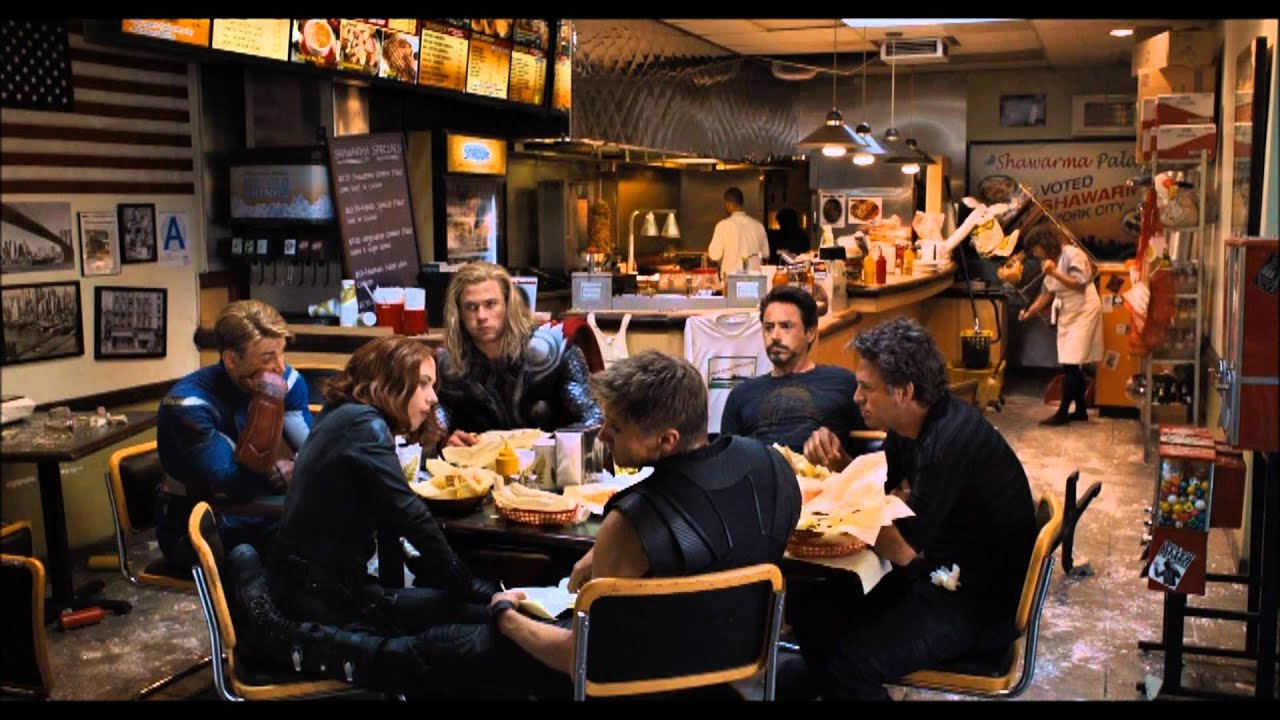 between the intense rains and the intensity of the repair, the afternoon flew. after getting back from our battles, we found ourselves in a local Hong Kong cafe over heaping plates of eggs, noodles, barbecue pork, and milk tea. reminded me of this:
we jumped the transit system and headed to Kowloon to sync up with the CU team about 10AM. the Hong Kong MTR is amazing and deserves it own post later. when we exited the train station it began to gently rain. soon the storm turned into a maelstrom of water moving parallel to the ground. we ducked under cover as best we could but the MTR lets out on the opposite side of campus from the CUHK Creative Media Centre. using the buildings and walkways as cover we crossed about 2/3 of the trip as the rain grew harder. we finally found one more covered walkway which ended about 100 feet from the CMC front doors; as we turned the corner there was Jane and some of her students with umbrellas ushering us into the building. Jane got us a moment to sit and gave us tea to smooth the trauma, but we soon got right to it.
enter, Ivan Zhao, brilliant research assistant to Professor Prophet, who had already cut us multiple copies (and 3d Fdm printed some too) of the file to replace the damaged piece. he consulted with us on the repair and found me a rotary tool to carve away the old piece. Annick Lung also joined us and was very helpful; she helped us make contact with another CUHK professor to advise us on chartering a boat for later in the week.
Monday, May 09, 2016
Heroes in our midst
Yesterday, I was reeling abut the damage done to the submarine ROV I brought to HK.
Thankfully my hero, amazing artist and Mensch: Jane Prophet has graciously offered to host us visit the labs at City University of Hong Kong to laser cut the replacement part to repair the submarine. I was so stressed all yesterday. Jane called me in the late afternoon and connected me with her Senior Assistant Ivan. I am truly fortunate to have such generous colleagues who can make opportunities like this happen.
Thankfully my hero, amazing artist and Mensch: Jane Prophet has graciously offered to host us visit the labs at City University of Hong Kong to laser cut the replacement part to repair the submarine. I was so stressed all yesterday. Jane called me in the late afternoon and connected me with her Senior Assistant Ivan. I am truly fortunate to have such generous colleagues who can make opportunities like this happen.
Ivan is the man; we worked out issues with the file and he confirmed with me. He also gave me a listing for an acrylics place in HK, so if I need to totally rebuild this tube we may have options.
We will be heading to CUHK at 11AM tomorrow. Wish us luck!!
Sunday, May 08, 2016
Hong Kong... we have a problem.
 |
| Bits of the OpenROV collar on left. |
 |
| Battery tube collars seen on the bottom left. |
The problem is is with that circular piece seen at the bottom left of the image I stole from OpenROV (thank you guys). These rings retain the battery cap. No bueno!!!! UGGGGGH. 4000 miles to HK, something like this I guess is part of the program...
Time to solve this, NOW!! So I spent a few sleepless hours until 3AM trying to find some google listings for acrylic and laser cutting outfit but I think there maybe a translation problem. It is unclear if these firms do one off jobs or there are other kinds of solutions. i have put a call into my contact at City University of Hong Kong, maybe she can help us with connecting us with a local group. I am also trying to sync with the local Makerspace: Dim Sum Labs.
Sunday, January 17, 2016
Turbidity Paintings hardware build begins
 |
| image from OpenROV http://www.openrov.com/products/2-8.html |
i was awarded a Florida Research Fellowship in November which included a seed fund to purchase the hardware and get the project kicked off.
we proposed that in the act of capturing abstract images underwater we would also be creating a database of images that could be analyzed by water quality researchers. the title, Turbidity Paintings, is a nod to this idea—turbidity is the measure of particles in suspension in a water column. our project will use two OpenROV units to capture these images and other key water quality data such as nutrients, dissolved oxygen, etc. these data will be used to name the abstract images merging the images into a concurrent state of data and aesthetic object. See: http://turbiditypaintings.com/
the project has gotten some interest in art/science communities and hopefully i will be announcing some other exciting news soon. it has also garnered some attention by environmental science and i have a research assistant from Dr. Matt Schwartz at UWF Earth and Environmental Sciences. we began collaborative research initiative and i will be working with Haley, a production/research assistant from that department.
Colleen and i put in a good 4 hours today; here's a timelapse of Build Day 01. We estimated about another 10 hours of build time until we can hit the pool for testing and learning to drive.
Monday, December 21, 2015
Sunday, December 20, 2015
some headway
during the last few days, i have been working pretty diligently on writing code to in order to make the interactive response to the EEG data more organic. i have been able to get data response (light) mapped to a specific data (waveforms from alpha, beta, etc.). for about the past four days. my observations are that this mapping results in a jumpy output; the lighting is responsive to the latest reading and immediately goes to the next number. more often than not any two adjacent readings have a decent span between the numbers and then lighting rapidly dims or brightens.
my work over these days has been to learn how to engage multitasking on the Arduino stepping out into interrupts and timer functions in order to measure the data over a longer period or grab two data points and then create a smoothing effect over the light changes. or in other words to take value currentReading - pastReading and divide that difference into 8 steps of change (fading in or out).
my work over these days has been to learn how to engage multitasking on the Arduino stepping out into interrupts and timer functions in order to measure the data over a longer period or grab two data points and then create a smoothing effect over the light changes. or in other words to take value currentReading - pastReading and divide that difference into 8 steps of change (fading in or out).
Friday, December 18, 2015
diagrammatronics
i don't even know what that means! :D this is a log of my continued research at Signal Culture
i have been really busy with the code on this EEG project and it is not easy.when i really hit the wall but need to get something done i have been focusing on making sure I have good diagrams to repeat the process. here are some of my Fritzing drawings. Fritzing is an open source diagramming, visualization and PCB layout tool that originated from the Fachshochschule Potsdam. the tool is invaluable in mapping real world looks at breadboarding and i use it in class all the time to help my beginner students see the layouts.

 the other two tools for diagramming and PCB layout seem to be very good. and the user community is strong, contributed libraries for parts seems to be growing at a reasonable rate and i have tried to draw a few of my own parts, but i need to practice some more on that! if you can manage that or find the libraries you need, you can even directly connect with a PCB manufacturer to get production boards made directly. i have not tried their services yet.
as you can see it makes it very easy to replicate and is a great option for the PCB design/production


images of all three: visualization on breadbooard, PCB layout for production and diagramming
i have been really busy with the code on this EEG project and it is not easy.when i really hit the wall but need to get something done i have been focusing on making sure I have good diagrams to repeat the process. here are some of my Fritzing drawings. Fritzing is an open source diagramming, visualization and PCB layout tool that originated from the Fachshochschule Potsdam. the tool is invaluable in mapping real world looks at breadboarding and i use it in class all the time to help my beginner students see the layouts.

 the other two tools for diagramming and PCB layout seem to be very good. and the user community is strong, contributed libraries for parts seems to be growing at a reasonable rate and i have tried to draw a few of my own parts, but i need to practice some more on that! if you can manage that or find the libraries you need, you can even directly connect with a PCB manufacturer to get production boards made directly. i have not tried their services yet.
as you can see it makes it very easy to replicate and is a great option for the PCB design/production


images of all three: visualization on breadbooard, PCB layout for production and diagramming
Thursday, December 17, 2015
Transmitters

i was reading a lot about the early microradio movement and getting tons of information from Tetsuo Kogawa's Polymorphous Space website. Here is a link to the famous Toward Polymorphous Radio.
in 2007 i built my first TV transmitter. i was able to transmit a picture across the room at the CADRE Laboratory reminiscent of Apollo Moon Landings video. i am reading Peter D'Agostino's anthology TRANSMISSION (Tanam, 1985)while at the Signal Culture research residency. i begun to wonder whether i should pick up this line of experiments again. as of today, there are only 7 nations that haven't really begun Analogue to Digital Switchover.
one of these is CUBA!! a really relevant place to be thinking about right now.


Wednesday, December 16, 2015
more images from Gernsback's work
Gernsback was also fascinated by telematics both passive and active from the looks of these inventions in personal viewscreens and telerobotic (medicine pictured here). Lastly, his proposal for a monument to electricity.


new inspiration HUGO GERNSBACK


Sunday, December 13, 2015
some practice with the new rig
after my initial successes, i then rebuilt the demo with 8 LEDs and cleaned up the wiring to stabilize all the hardware and add additional response range. i practiced for the next couple of hours to develop some control over the system.
i am seriously impressed with the response can already trigger. i realize that this is a simple graphing of one metric in of the EEG profile, but i have already experienced several characteristics of the biofeedback system that are noteworthy.
- it is hard to hold it at a level for a long period of time. i assume this kind of mastery will come with more experience. i can already light the rig with more control after just two hours of practice.
- abstraction is helpful - ironically it is easier to concentrate on the video image of the LEDs and get an active response. i am not sure what is at play here exactly but i theorize that when i look at the actual LED array, i also need to visually process the surrounding world and thus distractions are more plentiful.
- biofeedback - any self imposed distractions (holding my body awkwardly, tensing up, straining, etc.) actually limits my control. it is very meditative. A musician friend made a conjecture that such feedback could help in voice training so people could monitor the tension in their bodies. Very Jedi indeed.
"Do or Do Not... There is no try. - Yoda to Luke on Dagobah."
POC - EEG linked control

i imported the code from the tutorial and had only one small serial method change to make in order to update it to Arduino 1.0. My adapted code here.
my next challenge was to pair the headset and receiver. after re-reading the original directions, i realized it was a simple order of operations problem. to pair one must start with both off (including the headset must not be worn yet). power up the receiver module and then power up the headset. you may then put the headset on the subject. anytime i did not follow those directions strictly the system wouldn't pair.
within minutes i could watch changes in the LED responses; i tracked changes to emotional and tension levels
Friday, December 11, 2015
lots of prep to get ready
i dug in hard today on the project. after cracking the case of the receiving unit of the Neurosky, i spent a bit of time confirming pin outs and making sure my model matched the information i have gathered on the process. i started to wire up the bread board and i realized i was missing the voltage regulator; where the arduino sends data at 5v, the dongle takes a 3.3v signal. there were many reports of people burning out the dongles over a period time with this over voltage. suggested is the SparkFun Logic Level Converter - Bi-Directional
sigh...
so i sucked it up ordered a piece or two from amazon prime and paid for next day shipping and I will have it tomorrow. i realized as i continued to read up on the reasons why the voltage needed reduction that i could simply build a voltage divider as the team from Make a Mind-Controlled Arduino Robot had done. this is a simple process where you pass the voltage across two resistors in series leading to fractional adjusted voltage.

there are tons of calculators on the web, i used this one today and this one in the past to make multi-voltage supplies.
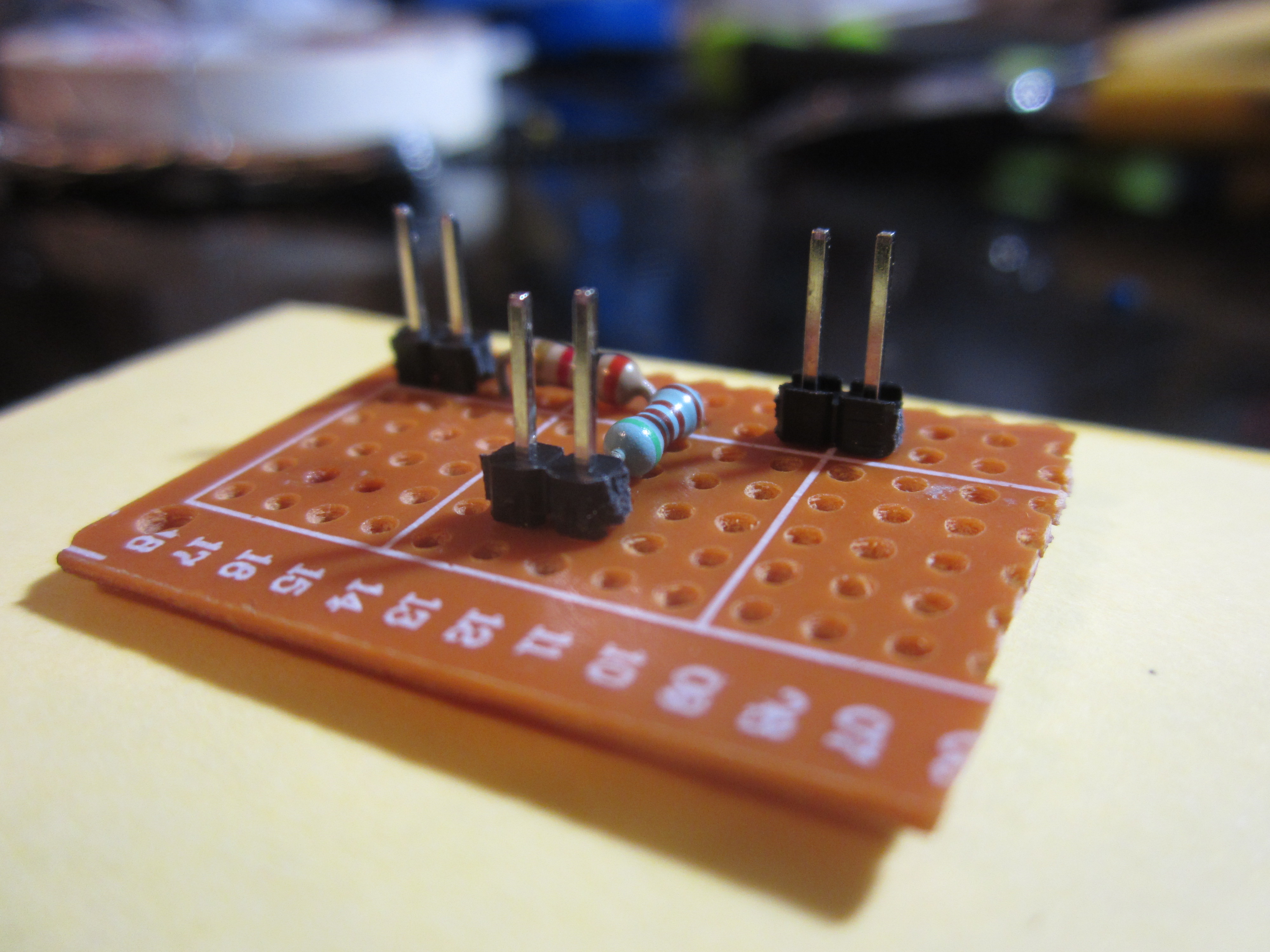
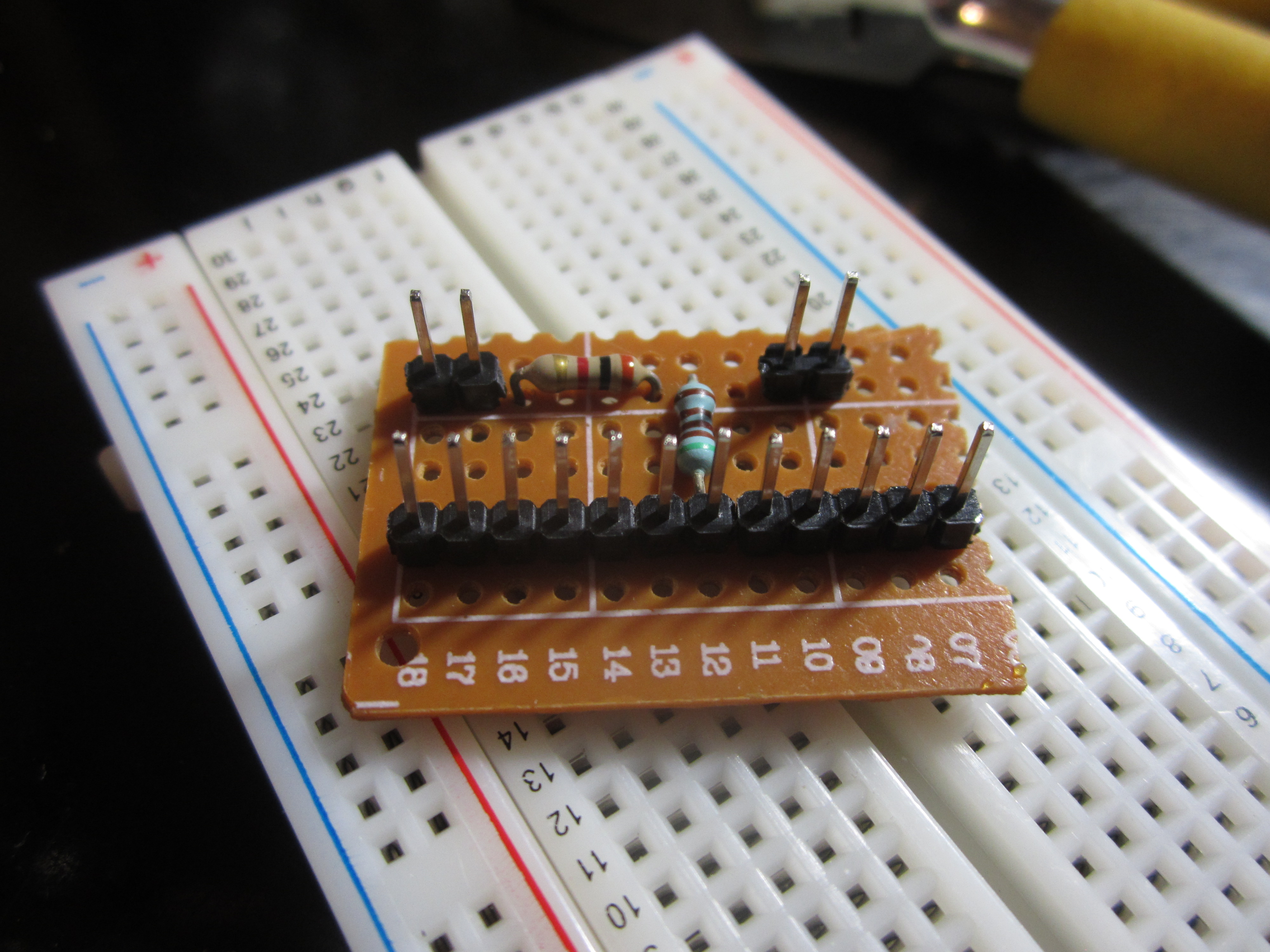
this is what I ended up with. and it worked beautifully with R1 = 1.8kΩ and R2 = 3.3KΩ
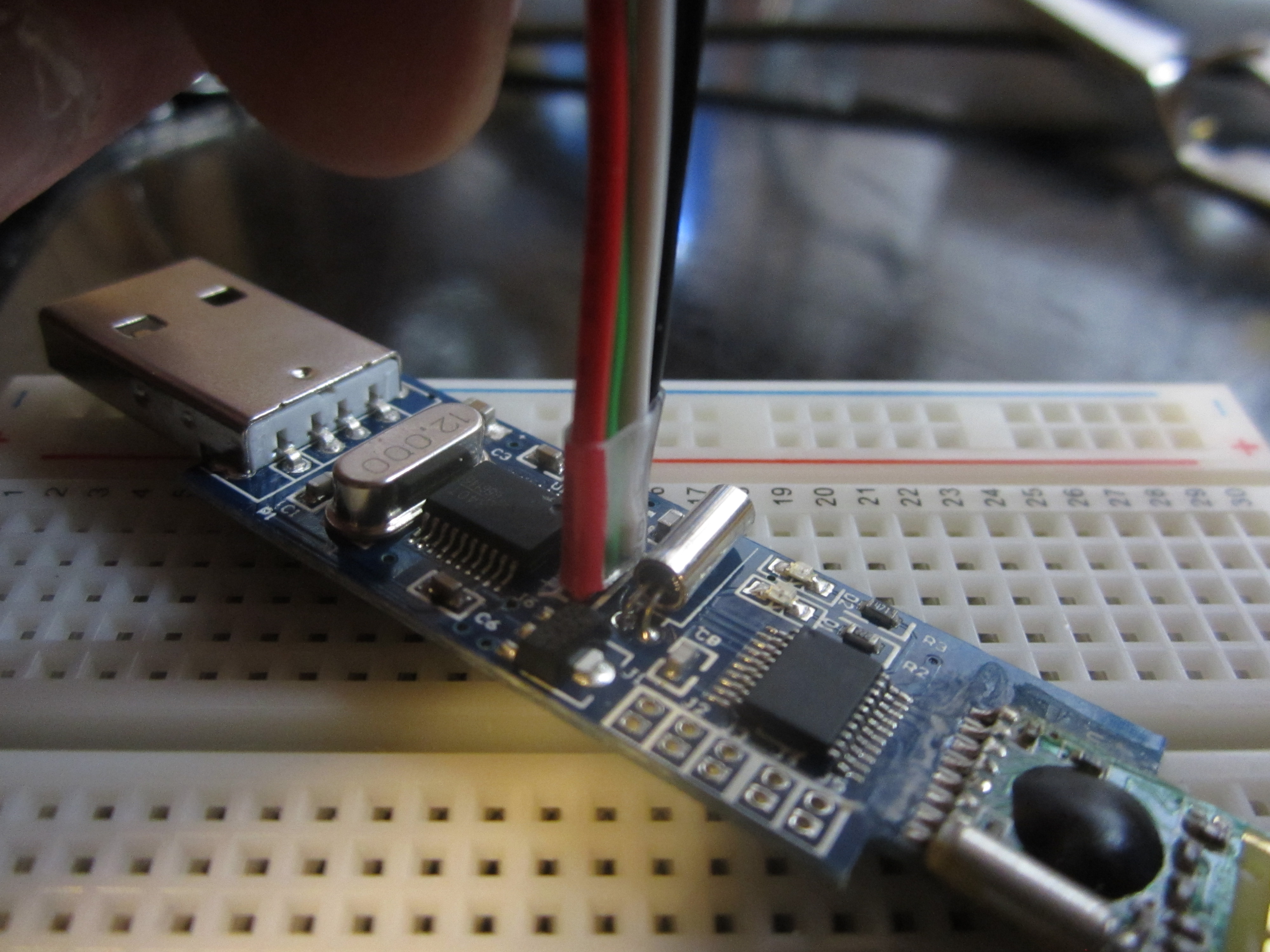
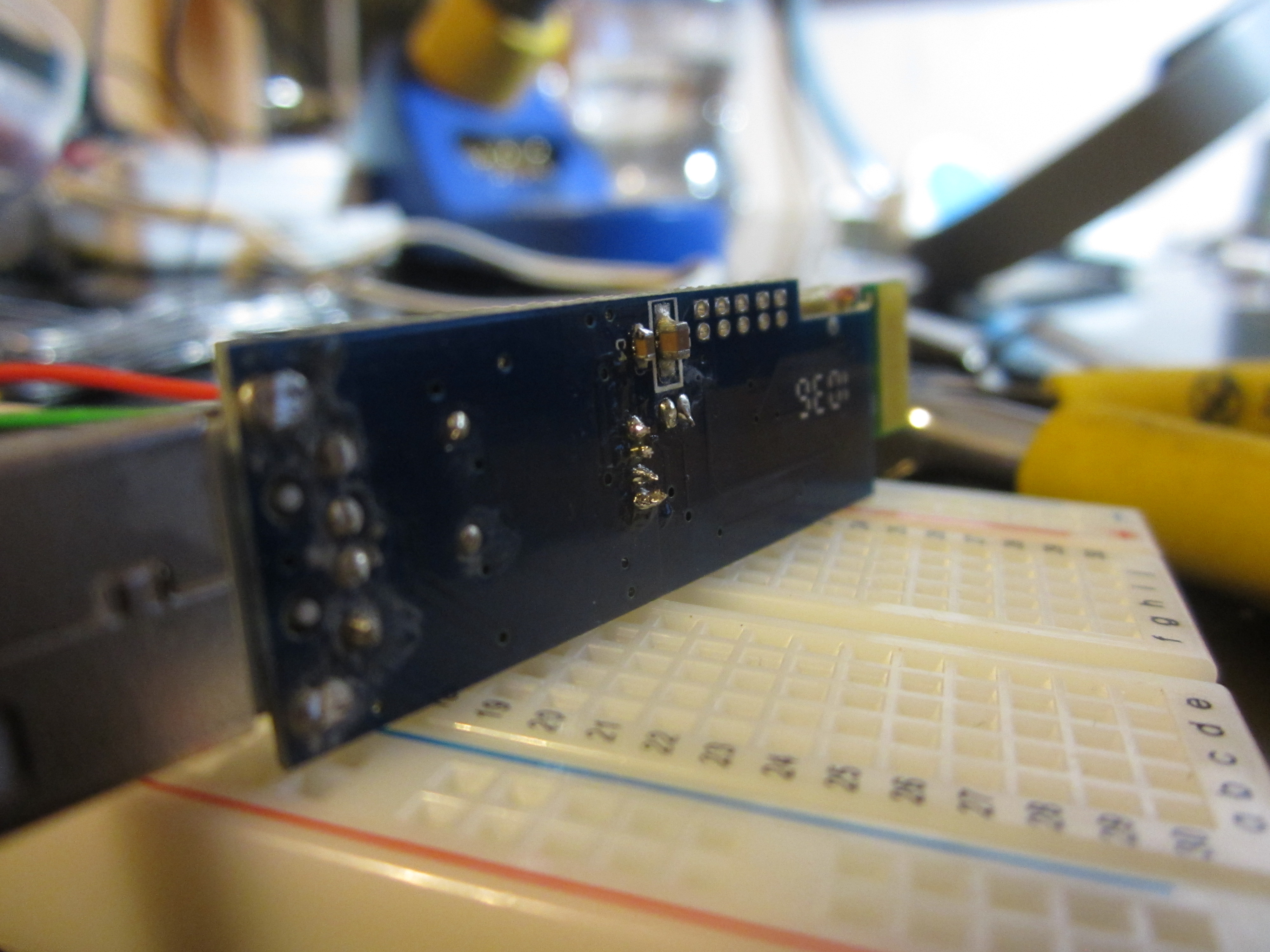 i also soldered wires to the pin-outs on the transmitter/receiver. note the shrink tube on the bundle as a stress relief and careful soldering on bottom to prevent shorts/bridges.
sigh...
so i sucked it up ordered a piece or two from amazon prime and paid for next day shipping and I will have it tomorrow. i realized as i continued to read up on the reasons why the voltage needed reduction that i could simply build a voltage divider as the team from Make a Mind-Controlled Arduino Robot had done. this is a simple process where you pass the voltage across two resistors in series leading to fractional adjusted voltage.

there are tons of calculators on the web, i used this one today and this one in the past to make multi-voltage supplies.
this is what I ended up with. and it worked beautifully with R1 = 1.8kΩ and R2 = 3.3KΩ
Subscribe to:
Posts (Atom)

