Showing posts with label exhibition. Show all posts

Friday, May 24, 2013

Otto's Ghost will be haunting Greensboro for Art in Odd Places (AiOP)

it is raining good news, i have received notification that Otto's Ghost has been accepted for the Art in Odd Places 2013: NUMBER in Greensboro, NC. the exhibition is a short period at the beginning of November 2013 in conjunction with the Southeastern College Art Conference (SECAC).

the boilerplate for the show:

AiOP is an artist-led initiative to present art that stretches the possibilities of the public realm. It began at the 1996 Olympics in Atlanta, and migrated with Ed Woodham to New York, taking place years later in the Lower East Side and East Village. Since 2008, the festival has taken place on 14th Street in New York City. We are excited to bring the festival to Greensboro for the first time and look forward to seeing it take place along Elm Street, one of the city’s most vibrant thoroughfares.
i have proposed to instll the project in a beautiful huge Magnolia tree located approximately at 500-­598 E McGee St on the triangular green belt wedged between McGee, Elm and RR tracks. The geo coordinates are 36.06807, ­79.79043 (paste into google maps). link to the map

Monday, May 14, 2012

Mineways woot!

as part of the V2V project (Valley to Valley), I have started using Mineways to extract data from Minecraft. my charge is to direct an installation build in CA and Russia for the September. Colleagues will be modeling the Silicon Valley(CA) and the Titanium Valley(RU) for the project in an effort to seek out the heart of these places. Mineways is a stellar app that I have been using to extract STL's of the project server (code named) Orwell. to date i have printed about 8 models and Mr. Bickford in SJ has printed a few too.

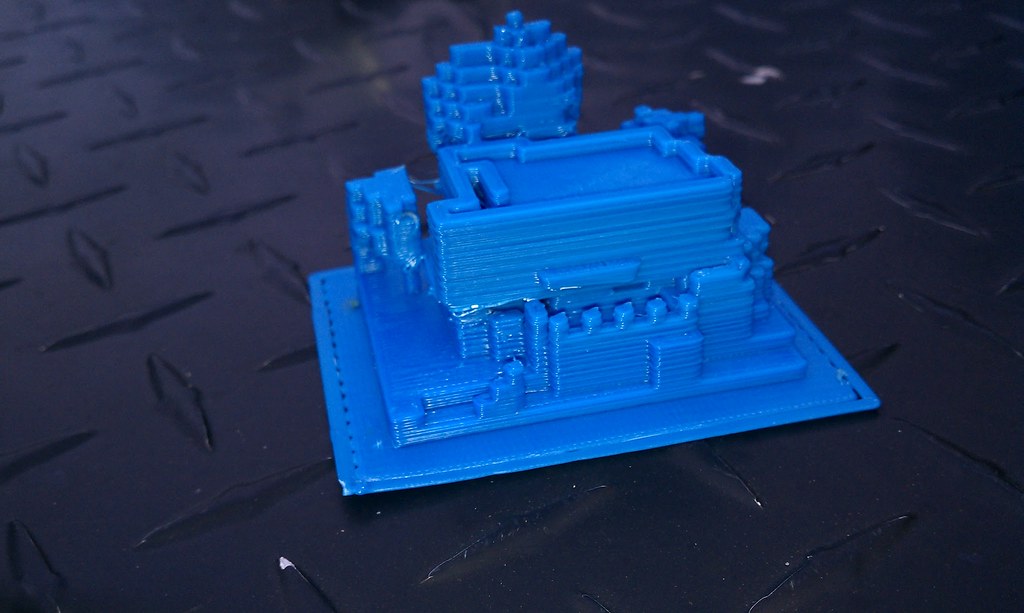
today i needed to distract myself from some idiocy on campus, so i printed a maquette of the momnument I am building for the V2V project. this is a dual print pieced together. i am not happy with the monument yet but holding it helps me make some choices in my redesign.

Wednesday, May 09, 2012

exciting summer... ¿break?

it was a small blessing and curse in the same breath when my boss said "Sorry we have to close your summer course due to low enrollment."

i have gotten it into my head to purchase a studio; in this depressed economy there is so much cheap real estate available down here on the frontier. one of my colleagues even told me that a professor emeritus from our department had both a dumpy old house in a poor part of town to use as a studio years back. and it looks really possible. there are literally 900sq. ft. houses here on a small lot under $15k.I really only need it to have a solid roof,and not fall through the floor. even with 15 year mortgage an 10% down the payments will be around $250 with all the trimmings or much less than renting a place from someone else. so i will miss the income from the summer job.

the blessings are that i accepted a position on the V2V project for the 2nd Ural Industrial Biennial (Ekaterinburg, Russia) and Zero1 2012 (San Jose, CA). I am leading the international teams on building the installations. we will be exporting data from the modeling of Silicon and the Titanium Valleys as we 'seek' for them. these models will be used as part of our exhibition design at each venue. pretty exciting stuff and i am getting to apply the research and explorations in 3D modeling i have been doing this past year.we are exploring lots of outputs, FDM, CNC, laser etching,maybe combinations to build the exhibitions. here are a couple of exports from this evening.

of course, a summer away from class planning is also opening other doors for me. i have started practicing with the Processing language again, studying the Unity 3D modeling engine, practicing more with the CNC, building up my local makers club, developing a theory course in the history of New/Computational Media, participating on an arts organization Board of Directors, and joining a Board for a new science and engineering museum for the Pensacola area.

i don't think i am going to get very bored...

Monday, July 25, 2011

21st Century Macrame: Open Source and the Maker Movement

i thought i would share the thesis statement for my lecture since i mentioned it in my first post on Kickstarter lessons. i will writing about the accompanying laboratory in this year's faculty exhibition pretty soon.

21st Century Macrame: Open Source and the Maker Movement
The re-emergence of the do-it-yourself culture as a social movement, cultural form, and genre.

In the latter half of the 1960's and throughout the 1970's, a group of independent artisans and everyday people shared a moment of intense creativity that sought to return to the 'handmade'. This group was motivated commercial culture; life had been subsumed by market, social, and industrial forms that arose post WWII. Heavily oriented around the then nascent Ecological Movement, this group sought to live closer to the earth, they encouraged the idea of sweat equity, and they desired to directly engage hands-on living. This generation spawned sewing circles, social justice movements, organic food co-ops, collectives, and communes around the globe following the Leary-ian mantra "Tune In, Turn On, and Drop Out". The Foxfire series, the myriad inexpensive 'how-to' publications form the era, and magazines like Mother Earth News are some of the artifacts that evidence the a desire for life without corporate mediation.

Today a new generational movement is flowering with many of the same goals of the 1960's and 1970's Love Generation. They are known colloquially as The Maker Movement; this group is motivated by many many of the same wishes of the earlier generation. They are decidedly anti-specialization and hands on, but they approach it with a very different set of politics—shaped by an increasingly interconnected world. Oddly enough this generation has weaved a relationship with factorization and corporations to achieve similar goals. They are at ease with any means by which they may create. The contemporary DIY peerage can comfortably outsource a new design to be manufactured via the miracles of print on demand technologies, create Frankenstein mashups of existent products, reapply older to ancient technologies as an option, or even ingeniously hack a commonly available materials to cobble into new, cheap, and functional fixes. Many of this generation's reverse engineers and hacks do this work as contemporary artists.

Monday, July 18, 2011

portraits from look art


look art opens


last week the project look art—a turbulence commission—opened and it even seems like it has been well received. it has taken me a couple of days to recover, because i was testing right up to the last. my insomnia payed off; i was able to stack up the gallery and extras in time. i will wait for another post to talk about the extras.

this first instantiation of look art is three artist's take on the classic multi-user gaming format. known as a Multi User Shared Halluciantation (MUSH) or Multi User Dungeon (MUD), these socially (and usually fantasy) oriented game environments thrived at the advent of our network culture. partially an expression of the need to communicate and partially because the computing of the time could only operate with very limited graphics, these environments were (& are) the domain of text. akin to today's fan fiction or that era's choose-your-own-adventure novels, this was(& is) a highly interactive platform that were shifted toward a high level of imagination rather than a suspension of disbelief.

i proposed to use the space to explore Lewitt's art and language methodologies. my work with geometries and pattern in the space bored me and i soon found it was much more interesting to work with portraiture. i began to incorporate the social aspect into the work by painting a series of colleague portraits. the process was challenging it required me to use photo processing, automated coding, and then i spent a considerable amount of time (sometimes hours) at the end on the portraits 'correcting' the ASCII characters to build better images. in the end it was much closer to my traditional painting process than i first imagined it would be.

the other two pieces in the show are very intriguing exploratory works.

Christopher Poff has created a interactive manifesto that burdens the players with the weight of Meaning and Purpose as well as Artist and Art. Alejandro Duque is using the work to prototype out a mixed realities type of piece where he wants to connect up physical interfaces with the MUD. this is definitely an intriguing idea and i will be watching his progress closely.

if you want to go in with a guide, i would be glad to play Virgil, just drop me a line.

Friday, August 06, 2010

the Burden Identity


yesterday i visited the Contemporary Art Museum (CAM) at USF; the show which closes in a few days is Broadcast, an introspective on the nature of artist utilization of the old mass media. how did the one to many model shape us? what strategies did artists use to circumvent the gauntlet of FCC, advertisers, and affiliates? there were many excellent projects that create interesting documentaries of the beginning of the McLuhan global village against staid nationalistic perspectives. Other projects portent the fragmentation of old media central command by introducing methodologies that deliver the means of production to anyone crazy enough to use them such as a pirate radio station set up in the gallery and live so that the public may sit down and use the equipment at will. Or TVTV/Top Value Television's projects where the artists develop their own network to engage the methods and gain access to the leadership of the world.

another formative piece in culture jamming/DIY culture is a reel of 4 Chris Burden videos known as Four TV Commercials, 1973-77/2000. the compilation of work was originally developed and aired on Los Angeles and New York market broadcast stations in the 70's. the collection includes: T.V. Ad: Through the night softly, Poem for L.A., Chris Burden Promo,and Full Financial Disclosure. The video which has been relatively left in it's native quality of the time was shown through a 20 inch CRT. abundant amounts of the video interlacing, static graphics, and low resolution reflected a distinct aesthetic experience of the pieces, even though i fully believe the intent of the artist was indictment of the market system, advertisement, and mass media. nostalgia and a creepy feeling about high definition and 3d which has been growing within my psyche recently, reinforced the attention i paid these seminal pieces. crumbweb has a copy of the statements on the reel, here.

Thursday, May 20, 2010

a /hug update


i am at the school studios late tonight finishing up a resize of one of the /hug vids. we were invited to exhibit the /hug training video: a message from /hug at the Salisbury University Electronic Gallery. the invite describes it as a
"special summer show is an invitational single channel exhibition of artists working outside the video genre, whose work will be featured in video formats."
this may be my all time favorite collab. it brought together so much good stuff. here's a link to the video in the case ya want to watch.


    credits
  • videographer
    • Liz Solo
  • script
    • kidNeutrino
  • actors
    • Kyungwha Lee
    • Liz Solo
    • Ali Sajjadi
    • James Morgan
    • kidNeutrino
    • Mez Breeze
  • editor
    • Liz Solo

Wednesday, April 29, 2009

fluoxetine gets nicknamed 'fluffy' by museum staff

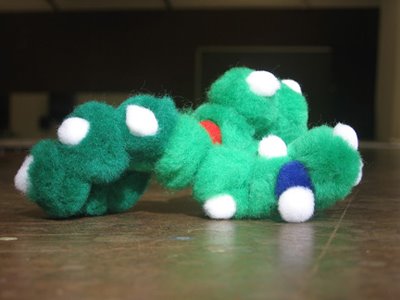
i happen to be in Ohio at this moment, (it is a long story... there might be a job opp here). right before i flew out i decided to see what was the date for the opening of Molecules That Matter exhibition at the College of Wooster Art Museum. Unfortunately they had been closed when I could make a call. today i was able to make that call and fluoxetine is 'standing' tall and proud. the curator's have taken a shine to the piece and it is affectionately known as 'fluffy' at the museum. the show runs through May 10 if you happen to be in the neighborhood. to the left there is a shot from the gallery.

Thursday, March 12, 2009

the big gallery week


the show is installed at SJSU and i have added to my former comments in statement below. i was replacing the statement printout when i found this on the outside of my gallery. http://twitpic.com/25oa6


planar array antennae paintings
thomas asmuth March 2009

This project is an exploration of non-optimal aesthetic design theory as proposed by Anthony Dunne1. I have used a fractal/self-similar formula known as the 'dragon curve' to draw the formal linear element and a planar antennae. These elements are packaged in the form of a painting, a merged idea of aesthetic and communicative value. The linear element in each painting utilizes gold leaf for it's symbolic and conductive properties. The length of each segment is 'tuned' to a quarter wavelength of a particular channel of the 802.11 standard and allows the work to merge with the local network and become part of the delivery of the network.

There are multiple points of view to situate this project into a historiography of art practice. First, through the implicit connection between circuit design and drawing, we can develop a rubric for formal analysis of the object. Drawing and the linear form is integral in this work and in any circuit trace. The process for making a Printed Circuit Board(PCB) traditionally utilizes the method of etching; indistinguishable from the techniques used to make a printmaking plate. Etching is also reductive process of removing material to reveal something else largely akin to carving as a sculptural process. The technique in these pieces is a direct (additive method) application of the conductive material to establish the mark or drawing.

Antennas are transducers; that is, a class of

"...devices by which variations in one physical quantity (e.g. pressure, brightness) are quantitatively converted into variations in another."2

The term coined in the 1920's by the telecommunication industry is derived from Latin for 'to lead across, transfer’. The connections to art are multitudinous but, I have drawn parallels between antennae and liturgical or icon painting for their ability to facilitate lines of communication. in icon painting gold leaf is prized for its ability to shine as if it is lit from within as a demonstration of the light of God. Today along with the exceptional spectral reflectance in wavelengths above one micrometer, gold is also particularly important as an excellent conductor and thus gold is a very effective media to build a transducer. Thus by use of the gold leaf for these works I am paying homage to historic and exploring contemporary methods of communication.

The theme of communication ties this work to Conceptual Art. Multiple layers of systems are embodied in the work. The linear element in each is the result of a rule set which calls for a mark of one length followed by another mark of one length made perpendicular to the first. The final complexity of the form is dependent on the number of iterations in which this rule set is executed. Each object is symbol and agent in establishing a site for communication analogous to Beuys' Rose für direkte Demokratie (Rose for Direct Democracy). In the 'Organization for Direct Democracy through Peoples Referendum', 1972 Beuys used the rose in a graduated cylinder to consecrate sites of discursive contact and as an institutional critique of the gallery/museum complex. Symbolically these paintings stand as objet d'art or sites for aesthetic or scopophilic discourse and gateways to the discourse of the network. This conflation is a purposeful attempt to make these two aspects converse echoing the spirit of Bauhaus or Droog design.

The multiple references and aspects of this project create a complexity that needs to be reconciled. It is a sort of transgenic genealogy that comes with penalties producing morphologically challenged entities. The visual structure yields nothing immediately identifiable as icon painting nor engineering design project. This is not a hybrid; the notion of hibridity suggests a confluence of form that is somehow compatible.

These objects reflect the ‘monstrous’ ritually assembled from widely variant materials such as industrial paint products, electron microscopy supplies, Medieval painting technique, late 20th century romanticism, and the piety of gilding as a symbol and messenger of light. Like a discussion between the three heads of the Chimera of
Arezzo,3 these forms are the assemblage of products, techniques, and which can be seen as a reflection of desire to facilitate a multilateral discourse.

The efficiency of the product in engineering value is murky as well. These objects give over to “How design can improve the quality of our everyday lives by engaging the invisible electromagnetic environment in which we live.”4 Circuit design and engineering are fields concerned with formally optimized spatial and electrical relationships. The pictorial space of these planar antennae are less concerned with optimization of the engineered space than the aesthetic experience through image plane, self similarity algorithms and in the transmission of the network. Certainly, there are specifications that are peculiar to the design which must be maintained in order to serve some functionality (such as the segment length/channel ratio) but, this design is decidedly non-engineered as to the optimal utility of the spectrum. These device-object-tool-fetishes seek an optimization of aesthetics while maintaining reasonable functionality in engineering.


1. Dunne, Anthony. "The Electronic as Post-Optimal Object." Hertzian Tales: Electronic Products, Aesthetic Experience and Critical Design. Cambridge: MIT, 2007. 1-20.

2. "Transducer." Oxford English Dictionary. 16 Mar. 2009 .

3. "Chimera of Arezzo." Scholars Resource. .

4. Dunne, Anthony. "The Electronic as Post-Optimal Object." Hertzian Tales: Electronic Products, Aesthetic Experience and Critical Design. Cambridge: MIT, 2007. 1-20.

Sunday, March 01, 2009

/hug


/hug |sla sh·həg|
noun [treated as sing. or pl. ]

/hug is the latest interventionist act of Third Faction, a non-factional guild/performance World of Warcraft group. /hug (prounounced: slash hug) is a Non Governemental Organization modeled after Red Cross/Crescent. /hug provides comfort and aid to all entities of the endlessly war torn world of Azeroth regardless of faction, allegiance, species, or creed.

/hug will be presenting a project space at the Laguna Museum of Art for the exhibition named: WOW: Emergent Media Phenomena, June 14 – October 4, 2009. the exhibition space will two parts. First is a theatre showing documentary and training machinima and the second section is a field work station where new recruits can immediately begin humanitarian aid missions in world.

/hug is a wordplay and represents a non-factional communication form that all players of WoW and all of humanity can understand, the hug.

Third Faction is a project-collaboration founded on Valentine's Day 2008 by members of the Ars Virtua, the acclaimed virtual worlds critical practice.

Tuesday, June 10, 2008

the unvieling of fontanaBot


6june2008: day 1020 of my graduate career and day 4 of Zer01 Festival 2008.

the public seemed delighted by the knife wielding robot known as fontanaBot. throngs of visitors crowded 1st street tonight and to my eye the numbers are here-to-fore unprecedented for the South Bay First Fridays. the event was ramped up for SubZero, an exposition of projects in honor of Zer01 2008. nearly 50 participants exhibited hacks, hardware, interactivity, and all-around art. here's a teaser video from us:


the hearing loss i am feeling this morning induced by the nieghboring project Drone Machines by Tristan Shone(which btw is an amazing project!) is a small price to pay for the downright success of fontanaBot's first public outing. the machinic artist executed dozens of works over 6 hours and evoked all the responses that one would expect from disbelief to amusement and back to disgust again, a little controversy is always good , no? read more at www.thomasasmuth.com

much to my amusement i learned that the other robotic art exhibition at SubZero was a project by my neighbor in Oakland three units down! the Boise Cascade has become a hotbed of hardware art.

Wednesday, September 05, 2007

molecules that matter


The Molecules That Matter show opens this weekend at the Tang Museum, Skidmore College. I am exhibiting my soft sculpture titled Fluoxetine. Here's a clip from the press release:

"SARATOGA SPRINGS, N.Y. —Ten of the 20th century’s most profoundly
significant organic molecules will be the stars of an unusual and innovative new
exhibition called Molecules That Matter, on view Sept. 8, 2007–April 13, 2008, at the Frances Young Tang Teaching Museum and Art Gallery at Skidmore College.
In spotlighting ten molecules whose common element is carbon—a magnificently multitasking element—the exhibition will illuminate the science of the molecules and their historical impact, and will heighten both dimensions with a provocative selection of material artifacts and contemporary artworks related to each molecule.
“This mix of science, art, and material culture is quite experimental, and unlikely to be found in either art or science museums,” says John Weber, Dayton Director of the Tang Museum. Weber co-organized the show with Ray Giguere, the Skidmore chemistry professor who proposed the original concept and serves as the exhibition’s co-curator and scientific overseer.
For Giguere, the exhibition represents an important look at the history of organic chemistry and an exciting new way to introduce non-scientists to the vital but invisible role that chemistry plays in their everyday lives. “Molecules That Matter explores our expanding knowledge of the invisible world of molecules,” says Giguere. “Throughout the 20th century, our knowledge of the molecular level has significantly defined our world, and even life itself. How we have changed as a result of this remarkable molecular evolution is the overarching story the exhibition conveys.”

Thursday, August 02, 2007

sf three minute film festival entry

slow progress for democracy accompanied by flipper


is our response to the slow progress of democracy of the western
hemisphere, the trapped feeling that one gets watching the clock,
knowing that it is wrong and staring in the face of the opinion of
the world. this steady sabotaged march is marked by nostalgia for the
past and an almost cruel misunderstanding of web 2.0. god bless the
french and their democracy, god bless the dolphins and live secure in
the knowledge that it only takes 2.5 minutes to make a 3 minute movie.

the pierres
Thomas Pierre Asmuth
John Pierre Bruneau
James Pierre Morgan


a screenshot until the film premiere

Thursday, May 10, 2007

fang quai 2007
The Fang Quai Awards were tonight, CADRE's night of glamour with Rachel Beth Egenhofer and Joel Slayton as your tag-team emcees. Fang Quai 2007 was hosted by the Anno Domini Gallery (you guys rock!). Featured also was the video work by the 105 crowd.

The night included many important announcements. Rachel Engenhofer announced that she has decided to pursue a residency in the UK. Also Joel announced that Sarah Lowe's chandelier will be hung in the Clark Library Building!

The big moment is here, the grand unveiling of the 2007 Fang Quai trophy by yours truly.


This year Fang Quai is a modular sculptural piece designed by me and manufactured by the Lego Corporation. DIY Fun is the name of the game! The award comes in a custom designed box with all the pieces to construct the artifact; also, you receive a disk with all the tools you need to complete your creation. The disk includes the Lego Digital Designer software, browser compatible instructions, and a video tutorial. The Fang Quai 2007 is also now part of the Lego Creations Gallery a collection of Lego designs from enthusiasts from around the world.

Monday, April 17, 2006

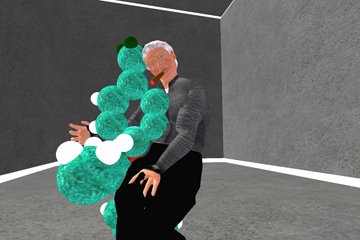
My application to a show called The Real has been accepted. I will be bi-locating my project Fluoxetine in cyberspace and meatspace. I am building a sculpture in Second Life a MMO in which some of the alumnis of CADRE have started an online new media arts center called Ars Virtua. The opening is April 29, 2006 look for the invites soon.

Here's the call:
Ars Virtua Gallery and New Media Center is looking for works for our
inaugural show. The theme of this show is "The Real" and will be
exhibited on the grounds of Ars Virtua which is located on the border of
Butler and Dowden (http://slurl.com/secondlife/Dowden/41/58/52/) in
Second Life (http://www.secondlife.com)

We are looking for 2D media, video and sculpture (including scripts)
produced within the 3D engine. All representable media will be accepted
for consideration but artists are cautioned to be economical with the
number of prims used in sculpture.

For too long "the virtual" has been supplanted by "the real" in the
realm of communication and entertainment. We recognize that there is no
need for replacement, but for extension. We see that 3D game engines are
creating new environments with new rules that are just as tangible as
the old ones, but on new terms. Education and art have been waking up to
value of simulation as it relates to and does not relate to campus and
museum life. The value of simulation or perhaps the threat of it occurs
when simulation begins to trump that which it is simulating. That is the
purpose of this exhibit, and though it does not make every exhibit in
space-time useless or passé it does attempt to offer a wholly electronic
alternative, an "other" real.

"The Real" will be juried by a group of artists from the CADRE
Laboratory for New Media.


Here's my proposal:
Proposal for 'The Real’:

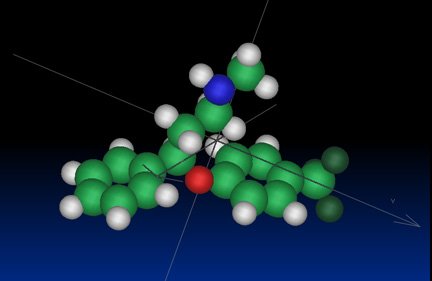
Fluoxetine is an anti-depressant pharmaceutical. It is a common prescription for conditions related to depression and panic disorder. My work titled Fluoxetine is a soft sculpture of the bio-chemical and is reminiscent of the plush toy transitional objects of childhood. Simultaneously, Fluoxetine is a prim-sculpture in the Second Life cyber-reality. The realspace and the cyber Fluoxetine are fetish objects to be held and cuddled as representations of the anti-depressant. The plush sculpture becomes a visceral realization of the coping mechanism made from the composite of bio-chemical functions and cultural connotation of the represented form.

I am constructing the Second Life sculpture with scripts that encourage the SL avatars to interact personally with the cyber-Fluoxetine as a simulation of the real Fluoxetine sculpture in which the public will be encouraged to publicly interact.

Thomas Asmuth


Tuesday, March 21, 2006


Manifesto of the Artist on 28 February 2006


a. The foundations of the world are beautiful in their natural geometries and form.

b. The essential theories and physics of familiar objects and substances become deeply imbued and burdened with the subliminal connotations of cultural utilization of these substance-objects.

c. I like to explore the philosophic landscape that is formed between the subtexts and substance-objects. On these topographies I often discover rich metaphors.

Thomas Asmuth


So it was with these observations I was able to sort of decant the reason I wanted to make a soft sculpture (or transitional object) in the form of a Seratonin Reuptake Inhibitor named Fluoxetine. This chemical belongs to anti-depressant class of pharmeceuticals and I wanted to make some work about them, the modeling used to explore the chemistry, and the subtextual meanings created through our employ of these chemicals.

The viewer should be able to hold and take comfort or play with the sculpture. The full size maquettes is being rendered in a stretch velour which is very sexy to the eye and touch.

Wednesday, November 09, 2005

Cloud Chamber Mark VI


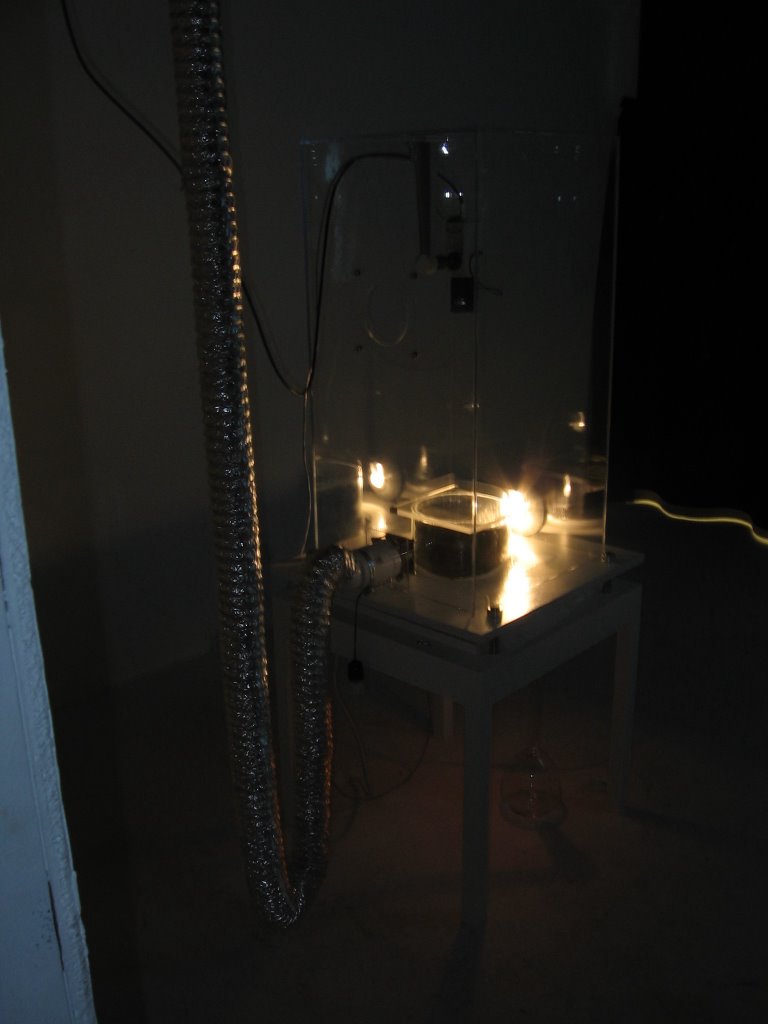
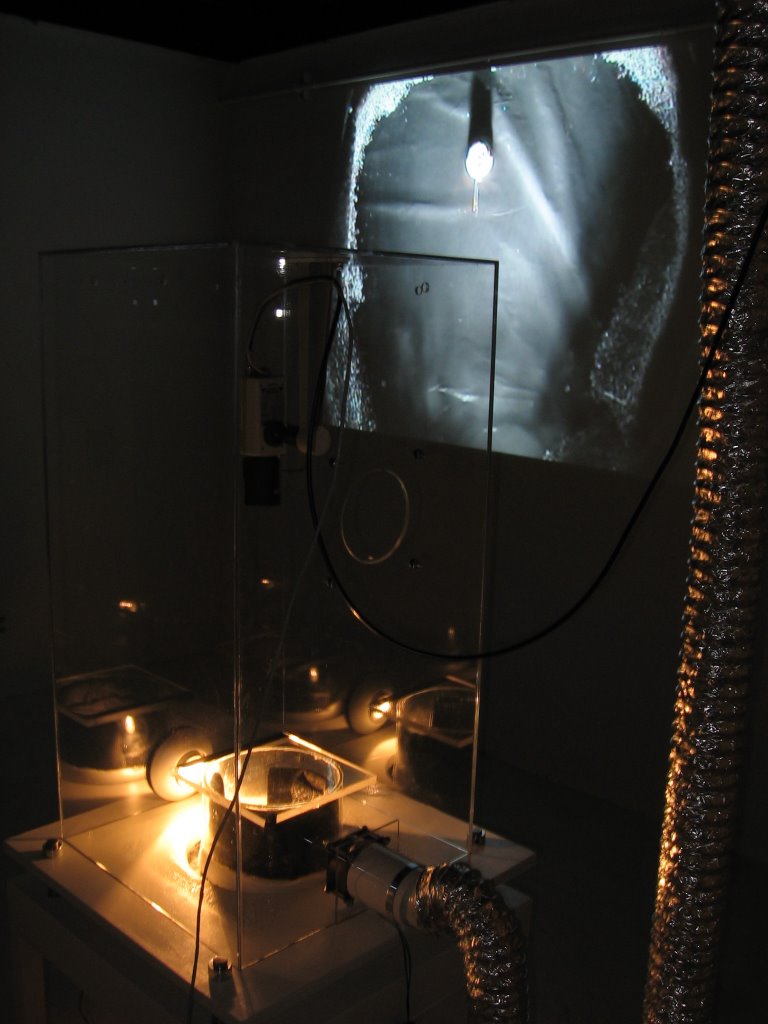
This is the sixth version of a prototype particle detector I have built over the last 3 years. I see Mark VI and its’ kindred are a continued metaphor on the themes of the nature of reality. Whereas painting is an extension of the illusory reality like the shadows in Plato’s Allegory of the Cave, these projects allow visual evidence of reality that intersects our lives constantly yet lies beneath the usual visual perception.

This tool, known as a Langsdorf Cloud Chamber, allows one to witness the passage of some of the fundamental particles that make up everything in the universe as they pass unhindered through our world. Like spirits they pass through air, earth, and flesh and bone. We are in rivers of energy. It ebbs and flows around and through us and thus questions the concept of inside and out. The fact that this is the same material that makes all things questions the reality of individuality and distinctiveness.

Discussion of the project:


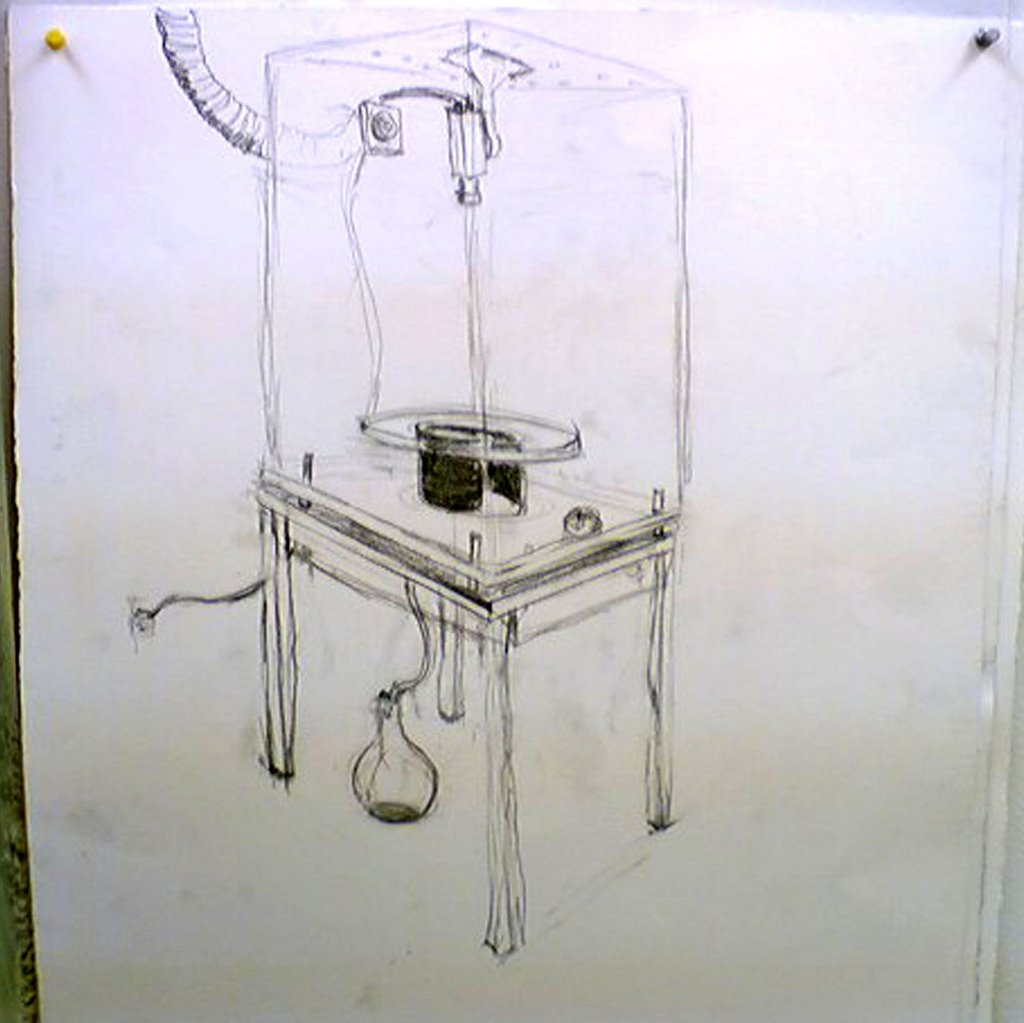
The cloud chamber project was recontextualized in a new format. The concept was to roll out the chamber in a transparent fashion revealing all of the components. The picture above shows the drawing I made in early October that started to form this idea. In my project I wanted to achieve a few (1) make a formal and aesthetic modernist statement in white and transparent media, (2) do good science, (3) have both of these themes play against one another to suggest the philosophical ideas I am concerned with. The fact that one can approach the experiment from all angles except below is highly effective strategy bridging those concepts of good public science and aesthetics.


Mark VI Technical


My scheme in this version is to illuminate all the parts and solve the problem with the focal length on the camera. In previous generations I had to adjust the camera as the angle the dry ice sublimated. The plexi structure solved the first issue by revealing all the parts; of course this required me to be very precise and neat in the fabrication, you cannot patch plexi very easily. The focal length issue was solved by making the table top ride down as it rode on ice. Four pins are intersect the platform holding ice as well as the second top on which the experiment sits. As the ice vaporizes*, the experiment and camera descend as a unit solving the earlier problem.
*dry ice goes from solid to vapor without turning to liquid at standard earth temperature/pressure, thus it is dry.

For two weeks straight I put in 15-18 hour days in the wood shop, making 5 or 6 trips per day to the hardware store to buy stuff, fabricating the Plexi box, doing research at the plastics shop. The actual craftsmanship became nerve-wracking. Even though all of the component took amazing focus, the custom work on the plexi box was a prime example.

Once the basic box was fabricated I needed to attach all of my equipment, which required careful cutting and milling of the plexi box. This took a lot of patience, as this material can be super fragile when cutting. Plexi shows any mistake so every surface was cleaned and padded between each move. Measure, make one cut, carefully clean, pad, measure, and so forth. Then repeat the procedure again. On top of that, the material costs were $200.00, the threat of breaking the materials meant I had to go excruitating slow: think out every procedure, discuss them with the shop manager, etc.

It was very important to me to fabricate each and every part of the experiment device. A few parts of course are off-the-shelf: the video camera, the fan, the ventilation hose... Overall I wanted to be the author of this sculpture. I wanted to use glass on the chamber itself for the longevity of the material. In the past I have used acrylic tube. The experimental components degrades acrylic. When I was offered a collaboration by Jeff Sarimiento of the SJSU Glass Lab, I eagerly accepted his proposal to make the experimental vessel. Mr. Sarimiento made a glass cylinder to my specs with the help of the glass blowing students. I feel that this custom labware only added to toward the formation an aesthetic object.