Showing posts with label biomimicry. Show all posts
Showing posts with label biomimicry. Show all posts
Monday, May 27, 2013

Wednesday, May 22, 2013
Otto's Ghost
some time ago i began to play with a solar sound circuit as research in autonomy, electronics, sound installation, etc. i had very vague feelings about how to build upon this project. this spring, i decided that my summer project would be to go for a truly embedded sound installation in the forest that surrounds our University of West Florida. it was very apparent that the many days of sun per year and dramatic shifts in the weather will create some manner of hybrid ecology of machine and nature as a resulting soundscape. in April, i applied for the Faculty Scholarly and Creative Activities Grant to seed the project. i applied for funding to pay for some new tools and to pay some summer assistants to help me realize the project. i am happy to report that it was funded.
 so i commence this summer in flurry of buying new equipment and starting a tremendous research period to learn more about PCB fabrication, Surface Mount Technologies, and mass production. i am building a reflow oven, refining my circuit design skillz, trying new techniques in applying resists, experimenting with new etchants, learning to apply solder masks, trying out conformal coatings, etc., etc.
here are gory details, pulled from my application:
my project with the working title, Otto’s Ghost, is a sound installation constructed from dozens of small solar powered circuits placed into the environment of a wooded site. the site and devices form a hybrid ecology between nature (landscape, trees, etc.) and technology (‘chorus’ of miniature sound robots expressing a variety of chirps, buzzes, etc.) Each module of the group can have an individual sound profile from the variety of the on board photovoltaics and values of components used in each piece. the soundscape manifests as the overall composition of the different ‘sonic speciations’ in the group and environmental factors. the generative soundscape of Otto’s Ghost is additionally influenced by environmental factors (diurnal cycle, weather, etc.) situating the environment as a coauthor in the score created by the installation.
Otto’s Ghost grew out of research from 2008, when i began to investigate autonomous machines and sound art in the installations of Ralf Schreiber (1996) who used the Schmitt Hex Inverter integrated circuit. the core circuit, the Schmitt trigger, is characterized by positive feedback where a portion of the output is fed back to input creating a loop gain (amplification) of the signal. this behavior was discovered by Otto Schmitt and documented in his 1937 dissertation on electrical propagation in nerve fibers of squid. Schmitt, now considered ‘a father’ of contemporary bioengineering, is also known for coining the term biomimetics.
Ralf Schreiber is a primary source in the application of these circuits as an aesthetic form. Like Schreiber, i am also using the oscillatory functions of the Schmitt triggers to create sound installations and feedback loops create chirps and buzzes. the current objective requires materials research to climate harden the devices to be implanted into the biological world. the project expands former research, first, in the transformation of the design and, secondly, by reinserting the machine embodiment of Schmitt’s inquiry as an element of the environment and a complication of the ideas of an ecology and (natural) systems to explore the aesthetics of an autonomous collection of machines as (machineorganisms).
Saturday, July 24, 2010
the summer's big research question, perhaps answered
as you might already know from a march post, i have been building autonomous little singing robotics. since our relocation, i have (naturally) been re-inspired by the pernicious environment of Florida. so much so that i wish that my artificial life-forms take place in the outdoors. which in turn, brings the question of how do electronics survive in a place where the humidity is so thick that metal will egregiously oxidize from contact with the air itself. i have several tools that I have owned for 15 or more years which never showed any corrosion that have turned completely rusty in the year we have lived here.

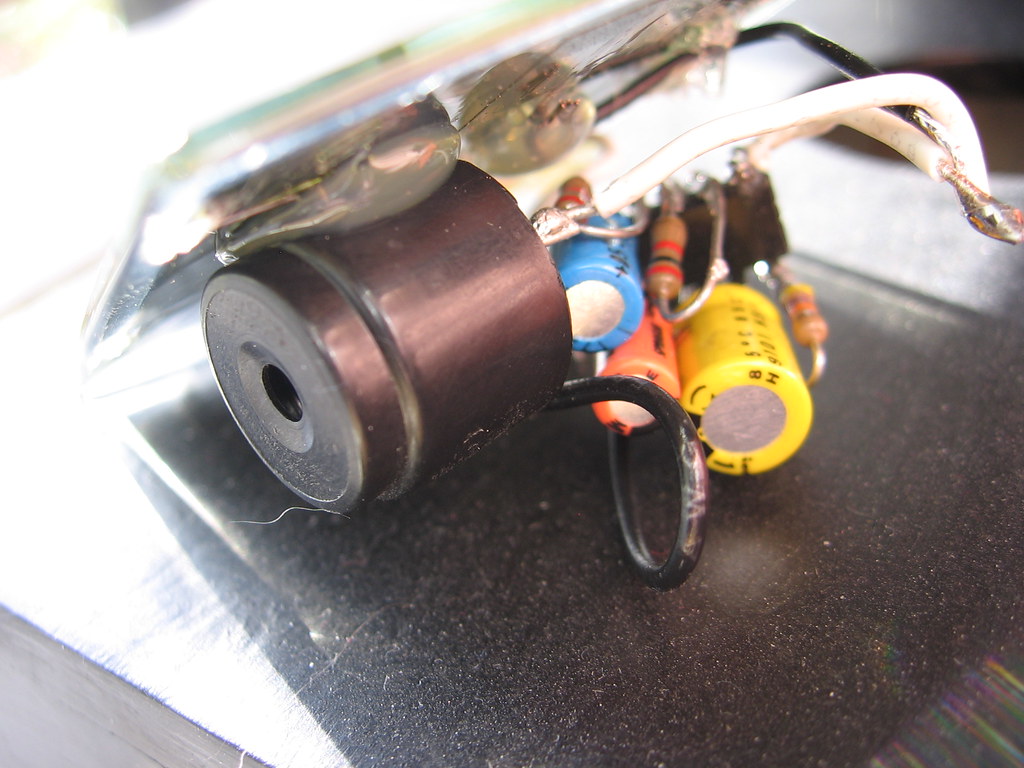
the obvious solution is to encase the the structures in a protective box, but i felt hesitant to employ this solution. there are formal sculpture qualities emerging from the component architecture which i find stunning. likewise, immersion of my babies(!) into blocks of resin seemed to cheapen the contours and assemblages of circuitry. and both of these ideas present all manner of problems to mounting of the piezoelectric transducers, the voices of my bots!
after a little web crawling i have discovered a likely solution:CorrosionX, a product used by the marine industry and RC hobbyists for waterproofing their electronics. the bonding technology sounds good, water and corrosion resistance seem to have a long life, promises dielectric properties up to 20Kv, and an invisible coat. the order has been placed and i look forward to my tests of the product. if this works well, i may realize my vision of truly embedding the critters into the environment for somewhat of a feral life.
Saturday, March 27, 2010

here comes the sun
i want to introduce two new autonomous circuits i have built and added to my e-beastiary. the circuits are variations based on the solarsoundmodul by Ralf Schreiber. the critters are photovoric singers that employ a Schmitt Hex Inverter IC, resistors, capacitors, piezo buzzers, and a photovoltaic cell. the modulation is slightly different on each output pin from the varied combination of capacitance and resistance. they range from creacking to screaming, lilting to terse. the lovely thing is that they change as the environment changes, of course chief is the angle of the sun to the solar cell, but unexpectedly and pleasing are other variables like movement, wind, fluttering leaves and branches which all effect the output. this produces a direct response to the environment reinforcing the autonomy of the critter.
my next goal is to embed them into the landscape. i have a fortunate opportunity that my current employment site is in the middle of a nature preserve. to be continued...
Subscribe to:
Posts (Atom)

