Showing posts with label diy. Show all posts

Thursday, December 17, 2015

Transmitters

today the new knowledge on Gernsback made me wonder about a project i shelved back in 2007. i spent a good amount of time on experiments in micro-broadcasting from 2006 - 2010. i built many FM transmitters from scratch that i used to form small bubbles of influence (temporary autonomous zones). i also wanted to tap into other media such as a colleague's iTunes partition on his laptop. i could broadcast Gary's playlists and mp3s throughout the art department. much of this research came from a sense of independent media and subversion of the bureaucracy official broadcast. the fire was stoked by desire to make handcrafted and to disrupt the culture of corporatized black box culture. if you don't void the warranty you don't own it.

i was reading a lot about the early microradio movement  and getting tons of information from Tetsuo Kogawa's Polymorphous Space website. Here is a link to the famous Toward Polymorphous Radio.


in 2007 i built my first TV transmitter. i was able to transmit a picture across the room at the CADRE Laboratory reminiscent of Apollo Moon Landings video. i am reading Peter D'Agostino's anthology TRANSMISSION (Tanam, 1985)while at the Signal Culture research residency. i begun to wonder whether i should pick up this line of experiments again. as of today, there are only 7 nations that haven't really begun Analogue to Digital Switchover.

one of these is CUBA!! a really relevant place to be thinking about right now.


Tuesday, May 28, 2013

solder masks! oh my!!

solder masks, oh my! i have started investigating the facility and methods need to make solder masks as part of my research to upgrade my homebrew PCB production. i recently purchased some UV curable ink; the price is right at about $15 per 50ml. it takes very very little. your objective should be to spread as thin a film as possible on the pcb. next you set up a typical exposure setup layering a mask over the parts that you don't want to cure (thus a positive process). you can make this tight by clamping the entire layers or use a vacuum exposure frame. i just lay a heavy piece of glass on the top to smoosh it together. when exposed to direct sunlight for about 3-4 minutes, it is enough to cross-link the polymers in the exposed ink.

i didn't understand how to set up the exposure 'sandwich' at first, the first ink never dried and I made a sticky mess of my screens. i soon learned that the cured material will not stick to polypropylene which can be sourced from your friendly 'zipper' food storage bag (Zip sumthin') or those clear sleeves for three hole binders...
so add a drop or two of ink, lay down a sheet of polypropylene, and squeegee the ink to a thin film. lay down and precisely align your mask, and expose. immediately after this first exposure use a rag with solvent (cotton swabs aren't bad either) to dab away the uncured areas over the pads. then set the board out in the light for a while to fully cure the ink.

    the results/lessons learned from my initial tests were that
  • i use too much ink; i am too used to painting with a trowel...
  • get all the air pockets out from under the poly
  • that stuff is hard to get through when fully cured
    • clean the pads thoroughly
    • easier to scrape away errors before the ink is fully cured
    • test all the traces before you got to all this trouble, you are locking yourself out of accessing the traces for repairs
  • did I mention the stuff gets hard

all-in-all, i have decided that this is a process i will have to practice many times to get down. the price can't be beat though. i found a dry film called Dynamask 5000, this is a film that i will cut to size and apply with the laminator. it uses a negative process close to the photo-intaglio processes i used to do in school. i will report on this later.

Saturday, May 25, 2013

improved toner transfer methods

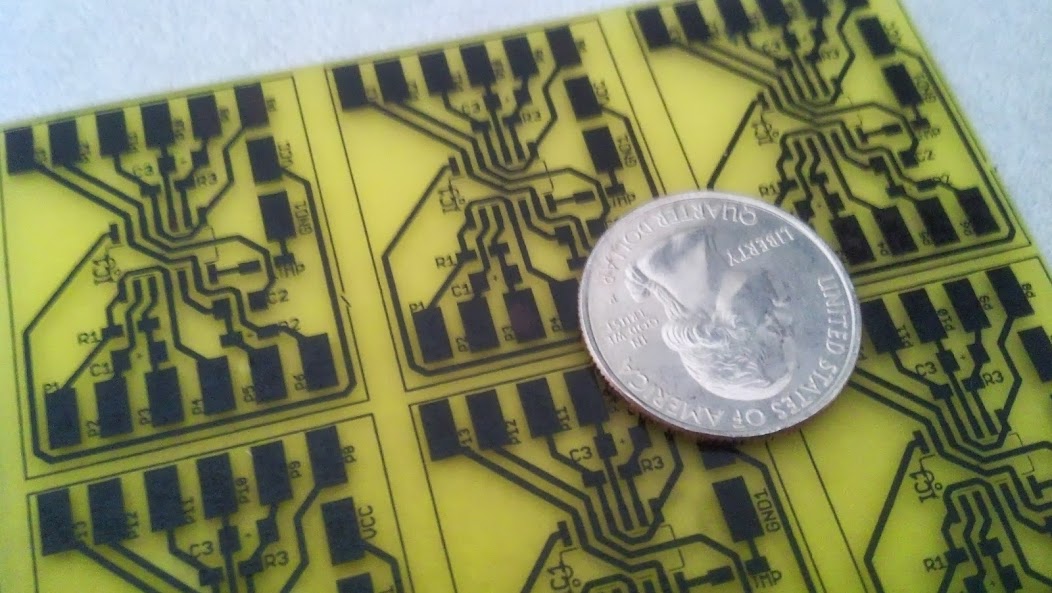
for about a year i have been making my own PCB's by using toner transfer methods. i have been able to make some pretty nice boards with very good results with all kinds of substrates; i have used plain paper, glossy junk mailer/magazine pages, and commercial transfer paper. the results have been very strong using the transfer paper, a dextrin coated sheet that the Laserjet easily prints to.i have been using the household iron method to remelt the toner to the board (simply put print side to copper and apply heat and pressure). i have found you need to be careful, because you can smear the molten toner. to solve this i have adapted a technique from the PulasFX forums where you use a hardwood dowel to roll the board between the iron and dowel. the action takes a little to master but it does quite well, i also bought a rolling pin and will sometimes go to Printmaking and roll right on top of the department hotplate.

the big improvement is a new laminating machine to assist with the toner transfer methods for making resists for my PCB's. i still use the iron to tack the transfer to the board but now the heavy lifting (pressing) is done with the laminator with a few caveats, the machine will grudgingly accept 1.6mm (1/16in) inch boards but i do not recommend it. the .8mm (1/32) boards do very well and last Thursday, i was able to fabricate some SMT plans with .275mm traces. i still have some smearing (i need practice on the number of passes in the laminator), but they look really awesome otherwise.

Wednesday, May 22, 2013

Otto's Ghost


some time ago i began to play with a solar sound circuit as research in autonomy, electronics, sound installation, etc. i had very vague feelings about how to build upon this project. this spring, i decided that my summer project would be to go for a truly embedded sound installation in the forest that surrounds our University of West Florida. it was very apparent that the many days of sun per year and dramatic shifts in the weather will create some manner of hybrid ecology of machine and nature as a resulting soundscape. in April, i applied for the Faculty Scholarly and Creative Activities Grant to seed the project. i applied for funding to pay for some new tools and to pay some summer assistants to help me realize the project. i am happy to report that it was funded.

so i commence this summer in flurry of buying new equipment and starting a tremendous research period to learn more about PCB fabrication, Surface Mount Technologies, and mass production. i am building a reflow oven, refining my circuit design skillz, trying new techniques in applying resists, experimenting with new etchants, learning to apply solder masks, trying out conformal coatings, etc., etc.

here are gory details, pulled from my application:

my project with the working title, Otto’s Ghost, is a sound installation constructed from dozens of small solar powered circuits placed into the environment of a wooded site. the site and devices form a hybrid ecology between nature (landscape, trees, etc.) and technology (‘chorus’ of miniature sound robots expressing a variety of chirps, buzzes, etc.) Each module of the group can have an individual sound profile from the variety of the on board photovoltaics and values of components used in each piece. the soundscape manifests as the overall composition of the different ‘sonic speciations’ in the group and environmental factors. the generative soundscape of Otto’s Ghost is additionally influenced by environmental factors (diurnal cycle, weather, etc.) situating the environment as a co­author in the score created by the installation.

Otto’s Ghost grew out of research from 2008, when i began to investigate autonomous machines and sound art in the installations of Ralf Schreiber (1996) who used the Schmitt Hex Inverter integrated circuit. the core circuit, the Schmitt trigger, is characterized by positive feedback where a portion of the output is fed back to input creating a loop gain (amplification) of the signal. this behavior was discovered by Otto Schmitt and documented in his 1937 dissertation on electrical propagation in nerve fibers of squid. Schmitt, now considered ‘a father’ of contemporary bioengineering, is also known for coining the term biomimetics.

Ralf Schreiber is a primary source in the application of these circuits as an aesthetic form. Like Schreiber, i am also using the oscillatory functions of the Schmitt triggers to create sound installations and feedback loops create chirps and buzzes. the current objective requires materials research to climate harden the devices to be implanted into the biological world. the project expands former research, first, in the transformation of the design and, secondly, by reinserting the machine embodiment of Schmitt’s inquiry as an element of the environment and a complication of the ideas of an ecology and (natural) systems to explore the aesthetics of an autonomous collection of machines as (machine­organisms).

Sunday, June 03, 2012

the Neutrino Food Labs is raging today

the Neutrino Food Labs is raging today, i started an experiment to culture my own cider yeast. over the past few weeks, i have been pining away for a good glass of home brew. we are very lucky locally because about 1 year ago the Pensacola Bay (micro)Brewery opened; they make a fine Brown ale which i have used as a component for my own fine chili. i am also spurred on by the price of a decent beer at the supermarket; last week when i wanted to grab a six pack for a small gathering i was holding the average price for a sixer of my favorites in domestics and microbrews was over $10. oooch! i went with a Leinenkugle specialty brew for about $8.

oi, i was feeling mighty sad this morning when the urge to brew came on strong. i keep missing the brew shop hours, they are closed Sundays and Mondays, because i generally have meetings all the rest of the week. then i saw an instructable by member, creasemaker, where he had sucessfully cultivated his own cider yeast from organically certified apples. not too many months ago i cultivated a strain of yeast for my sourdough breads, following some lore published by Peter Reinhardt. to do this, i soaked some organic raisins in warm water and slowly fed the critters in the tea flour and purified water. similarly, creasemaker took apples and soaked them in a good quality apple juice. my fingers are crossed and i can't wait to report back.

secondly, I was inspired by all the chatter on 'cold brewed' coffee so i started a pot today. i was impatient and i have dug into it after only 6 hours and it is amazing. very similar to a really lovely espresso, i think it is very high octane. i feel like i have taken some speed. lovely, delicious, Pete's French Roast speed, that is.

Thursday, May 10, 2012

the garden & chemical warfare

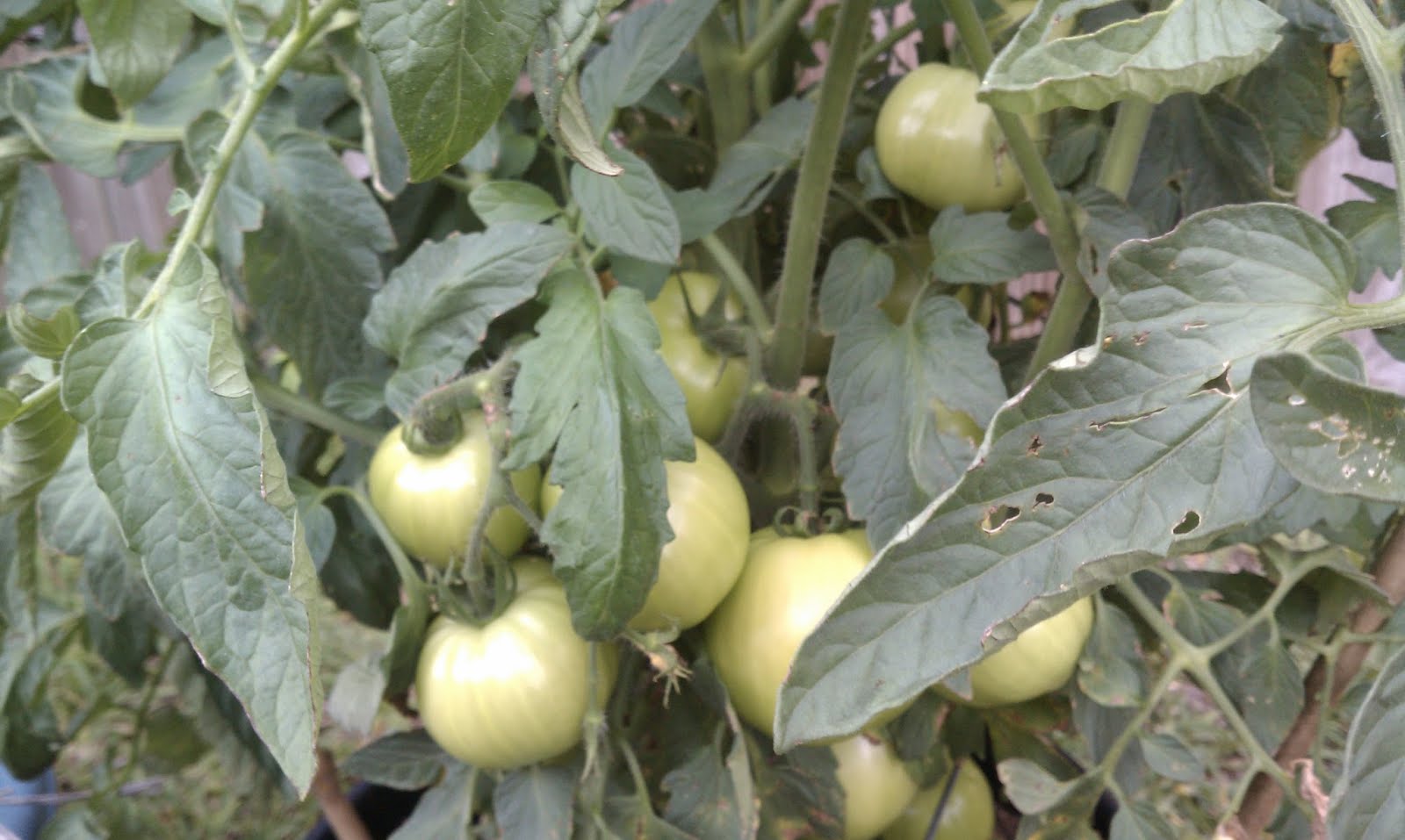
so my garden is moving along very nicely; the combination of the warm winter, being able to over-winter a few plants in a makeshift greenhouse, and some starts from the warehouse store gave us an aggressive start on this springs season. we have already dined on the first green tomatoes (fried greens baby!) and there must be 2+ dozen more fruit on the three already mature tomatoes. i have already made one harvest of Kung Pao peppers and the Datil peppers have fruit on the plants. about two weeks ago i notice some wilt on the large tomato vine. a few branches would turn pale yellow start to wilt, now i got seriously depressed because this will be our 3rd summer and it looked like our tomato crop would fail again. for two years we would watch the vine vigorously grow and almost get to fruiting stage and then the extra hot weather here or a swarm of insects would literally devastate them in 48hours. i can get good fruit from the local farming community but it is so satisfying to eat the produce you grow.


this past week i was tending the garden and i saw a cluster of orange-red six legged critters on the tomatoes, i wondered ifthese guys could be causing the wilting. after a couple of hours of digging, i discovered that they are the nymphs of to the leaf-footed plant bug. the adult Leptoglossus phyllopus have a flattened spot on their back legs that looks leaf like and are related to the common stink bug and ugly as sin. i immediately recognized the adults as the bastards that stripped 3 vines and desiccated the stems in the space of 36 hours two years ago. it was horrific how fast they could devastate a plant. sure enough upon my return to the plants later that day i found an adult and another cluster of nymphs.


i grabbed the adult and did a quick flattening of my own and quickly ran around looking for the other adults, but i could only find nymphs(small, pun intended) blessings. i picked and hosed off the buggers, but i was feeling conflicted because i really don't want to use a synthetic chemical/pesticide on the food plants. i followed up my reading about the species looking for alternatives. most sites immediately said that you can try a home-brew of natural soap and water, but it is a difficult pest to control. the soap (don't use a detergent!) breaks surface tension and essentially drowns the insect (i can live with it).

to concoct the brew, you combine about a tablespoon of natural soap (castille or animal) and optionally you can add a couple tablespoons of chili sauce as an irritant to dissuade the critters. i used sirracha because it also has garlic which is known for pest control too. the only castille soap i could get had peppermint in it, again peppermints are known to repel some critters. it has a odd aroma, but it is not a chemical pesticide in the Malathion sense of the word (though some people think it makes an awesome cocktail).

so far i am off work, summer class has been canceled) so i can do about a half dozen checks a day and spray the living hell out of the nymphs. i don't know with everything i need to do this summer if i can continue and i might need to do one or two sprays of the more intense stuff.

Monday, July 25, 2011

21st Century Macrame: Open Source and the Maker Movement

i thought i would share the thesis statement for my lecture since i mentioned it in my first post on Kickstarter lessons. i will writing about the accompanying laboratory in this year's faculty exhibition pretty soon.

21st Century Macrame: Open Source and the Maker Movement
The re-emergence of the do-it-yourself culture as a social movement, cultural form, and genre.

In the latter half of the 1960's and throughout the 1970's, a group of independent artisans and everyday people shared a moment of intense creativity that sought to return to the 'handmade'. This group was motivated commercial culture; life had been subsumed by market, social, and industrial forms that arose post WWII. Heavily oriented around the then nascent Ecological Movement, this group sought to live closer to the earth, they encouraged the idea of sweat equity, and they desired to directly engage hands-on living. This generation spawned sewing circles, social justice movements, organic food co-ops, collectives, and communes around the globe following the Leary-ian mantra "Tune In, Turn On, and Drop Out". The Foxfire series, the myriad inexpensive 'how-to' publications form the era, and magazines like Mother Earth News are some of the artifacts that evidence the a desire for life without corporate mediation.

Today a new generational movement is flowering with many of the same goals of the 1960's and 1970's Love Generation. They are known colloquially as The Maker Movement; this group is motivated by many many of the same wishes of the earlier generation. They are decidedly anti-specialization and hands on, but they approach it with a very different set of politics—shaped by an increasingly interconnected world. Oddly enough this generation has weaved a relationship with factorization and corporations to achieve similar goals. They are at ease with any means by which they may create. The contemporary DIY peerage can comfortably outsource a new design to be manufactured via the miracles of print on demand technologies, create Frankenstein mashups of existent products, reapply older to ancient technologies as an option, or even ingeniously hack a commonly available materials to cobble into new, cheap, and functional fixes. Many of this generation's reverse engineers and hacks do this work as contemporary artists.

Thursday, July 21, 2011

a lesson learned from kickstarter

i learned a boat load from our kickstarter experience. i am going to make posts over the next few days to get them down.

the model is good, but it is definitely geared toward product/business development. community development projects are a lot more ephemeral. i know that i am splitting hairs here; there are plenty of artists using kickstarter, but i see a big difference in those who are developing something like an album which is meant to be reproduced again and again by a manufacturing process and/or delivered by a retail method. i received a lot of messages that were serious and importantly asked "so what?". i do think this is a valid criticism to ask: "past the parlour tricks aspect of the device, what is it for?" business focused folks had a really hard time figuring out why we would ask for investment. i would like to share an email i got Monday. i have obscured the name for privacy:
Hello Thomas!

One of my friends shared your project with me. I watched your video about the glove and turning anything into a speaker. My question to you is "So what?". In other words: "What is the benefit of turning anything into a speaker?" "Why could this project be significant?" "How could it be used in the marketplace?"

I am not asking to be insulting but I am asking to help you help us non-techie people see the benefit and why it would be prudent to invest in your idea. If you could shed some light on that, I will be glad to share this information with all of my contacts.

Have a great day!
r.e.


in my reply i tried to decscribe why open source it vital for our world and told the person about another email i had recieved a few days earlier:

Hi R***,

These are all good questions and let me see if I can unfold it a bit and describe our motivations.

First a bit of background, James and I are developing this as an open source project, which is a concept that revolves around community development, strengthening an individual through 'know-how', and freely sharing information. It is a very academic pursuit which fits right in to my career as you can see. You may want to read more here: http://en.wikipedia.org/wiki/Open_source or you might want to see it in action look here www.instructables.com/

Now to our madness, 'contact transducers' (the tech bits we are using), are indeed used in commercial applications all the time. They get used in fixtures like lamps or other objects at a shopping malls to turn those objects into a speaker to play background music or advertisements. Our projects seeks to use the tech for other audiences. One scenario could be for a group of actors who could show up and do a live impromtu performance at some public space activating sound effects, music, etc. This could allow performers to really open up their interaction with the performance space.

One other application comes from a local person who contacted me. She is a care taker here in Pensacola that uses the same technology to treat children with Autism. It sounds as if they have planted transducers into furniture that the children use to calm themselves. She has the intuition that the touch combined with auditory stimuli could expand her treatment options with the technique.

And that is the great thing about open source. It encourages innovation. It is quite likely that there are dozens of applications using the gloves that James and I haven't thought about. We are academics and artists, so we have a different take on the project. It is not our intention to be the inventors of ProductX. The Kickstarter campaign is really to help support us in building community/share the thought with the world. So that is the basis for raising money with Kickstarter.

BTW I will be leading workshops on building this, and talking about open source as a movement in November at UWF. I want to build community here also!

Don't hesitate to write back if you have other questions.

cheers!
t-

Sunday, July 10, 2011

when it rains it pours!


YAY (mini)Maker Faire is coming to Atlanta! ...while i am in Istanbul. Wow. That was one of the fastest let downs in history.

¡you! yes, you. you need to go. unless you are accompanying me to Turkey this is a special thing, i was at Maker Faire 1 and 2. do not miss this opportunity.

http://www.makerfaireatl.com/Atlanta_Mini_Maker_Faire/Home.html

Saturday, August 14, 2010

i lurve Adium


i was intrigued by a post on the Lady Ada* website. the note referred to a technique of using IRC for the UStream chat/back-channel. i am a huge fan of Ustream and have been known to use it occasionally. one of the drawbacks is the chat. the video and chat running in the same browser winder grinds my machine cycles. when i was reading about the IRC settings the tutorial was using Pidgin and i was clued into the fact that Adium is built on the same programming backbone, purplelib, too bad they don't(didn't) support IRC. oh well it was worth a peek to see if things have changed...

wooot! the Adium beta has IRC! praised be! let the trumpets sound! did i say woot? here's a link to the beta if you wanna try it.

so i tested the suckah and it did great. pop out the UStream video channel on a browser winder and fire up IRC. my anecdotal evidence is that there were 100 plus people on the stream and i had maybe 20 sec lag. W0000T!


*Lady Ada for those of you who are uninitiated is one of the coolest proponents and geeks in DIY hardware and Phys Comp. they do a Saturday night show on UStream called Ask An Engineer. check it some time. her sites are ladyada.net and adafruit industries

Saturday, March 27, 2010


here comes the sun


i want to introduce two new autonomous circuits i have built and added to my e-beastiary. the circuits are variations based on the solarsoundmodul by Ralf Schreiber. the critters are photovoric singers that employ a Schmitt Hex Inverter IC, resistors, capacitors, piezo buzzers, and a photovoltaic cell. the modulation is slightly different on each output pin from the varied combination of capacitance and resistance. they range from creacking to screaming, lilting to terse. the lovely thing is that they change as the environment changes, of course chief is the angle of the sun to the solar cell, but unexpectedly and pleasing are other variables like movement, wind, fluttering leaves and branches which all effect the output. this produces a direct response to the environment reinforcing the autonomy of the critter.

my next goal is to embed them into the landscape. i have a fortunate opportunity that my current employment site is in the middle of a nature preserve. to be continued...

Monday, September 15, 2008

diy reaches maturity


i looked at this featured article How not to block cameras on instructables the other day and thought to myself: i might be witnessing the next step in the culture of diy. the fact is that this is a damned good review of the sensational project that shot across the net a few weeks ago.

what does it mean when the diy network users start really doing verification, peer review, and analysis? this is an amazing move forward when we can take back the property ceded to the cults of specialization (chew on that Keen!).

Randofo's parting shot: step 5Lastly... By all means, feel free to prove my test wrong with replicable results.

Bravo!

i think the caption in this lolcat style picture sums up his challenge to us: