After multiple rewritings of the code, I think I have a solution to the color sensor that reports the correct colors and luminance. I have also (PURPOSEFULLY!) shorted the LED on the breakout board so as to read the ambient light. This has allowed me to close up the assembly and I am prepared to attach this to the buoy body now.
We have a boat chartered for Monday and so tomorrow I need to construct a camera dolly, get the microcontroller and sensor wires installed in the buoy body, and check the NIR sensor so we are ready for the trip.
Showing posts with label physical computing. Show all posts
Showing posts with label physical computing. Show all posts
Friday, June 14, 2019

Getting after it: the data buoy project
 |
| An early design for the buoy. |
I have been working on this idea in rough terms for about 3 years. The Signal Culture residency period will give me the space to make some real headway on the idea.
During the first day, I was able to make some significant progress on the coding. I put together a rough prototype that allowed me to test out the sensor assembly I constructed with the Adafruit TCS34725 Color Sensor. Here's a video showing my first night's progress: Data Buoy 01
Tuesday, May 10, 2016
battling the Monsoons to repair the ROV
the whole team loaded up this morning to go visit Jane Prophet at City University of Hong Kong. Ivan Zhao and Annick Lung who work with Jane gave as a little assistance to repair the ROV damaged in air travel.
we jumped the transit system and headed to Kowloon to sync up with the CU team about 10AM. the Hong Kong MTR is amazing and deserves it own post later. when we exited the train station it began to gently rain. soon the storm turned into a maelstrom of water moving parallel to the ground. we ducked under cover as best we could but the MTR lets out on the opposite side of campus from the CUHK Creative Media Centre. using the buildings and walkways as cover we crossed about 2/3 of the trip as the rain grew harder. we finally found one more covered walkway which ended about 100 feet from the CMC front doors; as we turned the corner there was Jane and some of her students with umbrellas ushering us into the building. Jane got us a moment to sit and gave us tea to smooth the trauma, but we soon got right to it.
enter, Ivan Zhao, brilliant research assistant to Professor Prophet, who had already cut us multiple copies (and 3d Fdm printed some too) of the file to replace the damaged piece. he consulted with us on the repair and found me a rotary tool to carve away the old piece. Annick Lung also joined us and was very helpful; she helped us make contact with another CUHK professor to advise us on chartering a boat for later in the week.
 between the intense rains and the intensity of the repair, the afternoon flew. after getting back from our battles, we found ourselves in a local Hong Kong cafe over heaping plates of eggs, noodles, barbecue pork, and milk tea. reminded me of this:
we jumped the transit system and headed to Kowloon to sync up with the CU team about 10AM. the Hong Kong MTR is amazing and deserves it own post later. when we exited the train station it began to gently rain. soon the storm turned into a maelstrom of water moving parallel to the ground. we ducked under cover as best we could but the MTR lets out on the opposite side of campus from the CUHK Creative Media Centre. using the buildings and walkways as cover we crossed about 2/3 of the trip as the rain grew harder. we finally found one more covered walkway which ended about 100 feet from the CMC front doors; as we turned the corner there was Jane and some of her students with umbrellas ushering us into the building. Jane got us a moment to sit and gave us tea to smooth the trauma, but we soon got right to it.
enter, Ivan Zhao, brilliant research assistant to Professor Prophet, who had already cut us multiple copies (and 3d Fdm printed some too) of the file to replace the damaged piece. he consulted with us on the repair and found me a rotary tool to carve away the old piece. Annick Lung also joined us and was very helpful; she helped us make contact with another CUHK professor to advise us on chartering a boat for later in the week.
Sunday, May 08, 2016
Hong Kong... we have a problem.
 |
| Bits of the OpenROV collar on left. |
 |
| Battery tube collars seen on the bottom left. |
The problem is is with that circular piece seen at the bottom left of the image I stole from OpenROV (thank you guys). These rings retain the battery cap. No bueno!!!! UGGGGGH. 4000 miles to HK, something like this I guess is part of the program...
Time to solve this, NOW!! So I spent a few sleepless hours until 3AM trying to find some google listings for acrylic and laser cutting outfit but I think there maybe a translation problem. It is unclear if these firms do one off jobs or there are other kinds of solutions. i have put a call into my contact at City University of Hong Kong, maybe she can help us with connecting us with a local group. I am also trying to sync with the local Makerspace: Dim Sum Labs.
Sunday, January 17, 2016
Turbidity Paintings hardware build begins
 |
| image from OpenROV http://www.openrov.com/products/2-8.html |
i was awarded a Florida Research Fellowship in November which included a seed fund to purchase the hardware and get the project kicked off.
we proposed that in the act of capturing abstract images underwater we would also be creating a database of images that could be analyzed by water quality researchers. the title, Turbidity Paintings, is a nod to this idea—turbidity is the measure of particles in suspension in a water column. our project will use two OpenROV units to capture these images and other key water quality data such as nutrients, dissolved oxygen, etc. these data will be used to name the abstract images merging the images into a concurrent state of data and aesthetic object. See: http://turbiditypaintings.com/
the project has gotten some interest in art/science communities and hopefully i will be announcing some other exciting news soon. it has also garnered some attention by environmental science and i have a research assistant from Dr. Matt Schwartz at UWF Earth and Environmental Sciences. we began collaborative research initiative and i will be working with Haley, a production/research assistant from that department.
Colleen and i put in a good 4 hours today; here's a timelapse of Build Day 01. We estimated about another 10 hours of build time until we can hit the pool for testing and learning to drive.
Monday, December 21, 2015
Sunday, December 13, 2015
some practice with the new rig
after my initial successes, i then rebuilt the demo with 8 LEDs and cleaned up the wiring to stabilize all the hardware and add additional response range. i practiced for the next couple of hours to develop some control over the system.
i am seriously impressed with the response can already trigger. i realize that this is a simple graphing of one metric in of the EEG profile, but i have already experienced several characteristics of the biofeedback system that are noteworthy.
- it is hard to hold it at a level for a long period of time. i assume this kind of mastery will come with more experience. i can already light the rig with more control after just two hours of practice.
- abstraction is helpful - ironically it is easier to concentrate on the video image of the LEDs and get an active response. i am not sure what is at play here exactly but i theorize that when i look at the actual LED array, i also need to visually process the surrounding world and thus distractions are more plentiful.
- biofeedback - any self imposed distractions (holding my body awkwardly, tensing up, straining, etc.) actually limits my control. it is very meditative. A musician friend made a conjecture that such feedback could help in voice training so people could monitor the tension in their bodies. Very Jedi indeed.
"Do or Do Not... There is no try. - Yoda to Luke on Dagobah."
POC - EEG linked control

i imported the code from the tutorial and had only one small serial method change to make in order to update it to Arduino 1.0. My adapted code here.
my next challenge was to pair the headset and receiver. after re-reading the original directions, i realized it was a simple order of operations problem. to pair one must start with both off (including the headset must not be worn yet). power up the receiver module and then power up the headset. you may then put the headset on the subject. anytime i did not follow those directions strictly the system wouldn't pair.
within minutes i could watch changes in the LED responses; i tracked changes to emotional and tension levels
Friday, December 11, 2015
lots of prep to get ready
i dug in hard today on the project. after cracking the case of the receiving unit of the Neurosky, i spent a bit of time confirming pin outs and making sure my model matched the information i have gathered on the process. i started to wire up the bread board and i realized i was missing the voltage regulator; where the arduino sends data at 5v, the dongle takes a 3.3v signal. there were many reports of people burning out the dongles over a period time with this over voltage. suggested is the SparkFun Logic Level Converter - Bi-Directional
sigh...
so i sucked it up ordered a piece or two from amazon prime and paid for next day shipping and I will have it tomorrow. i realized as i continued to read up on the reasons why the voltage needed reduction that i could simply build a voltage divider as the team from Make a Mind-Controlled Arduino Robot had done. this is a simple process where you pass the voltage across two resistors in series leading to fractional adjusted voltage.

there are tons of calculators on the web, i used this one today and this one in the past to make multi-voltage supplies.
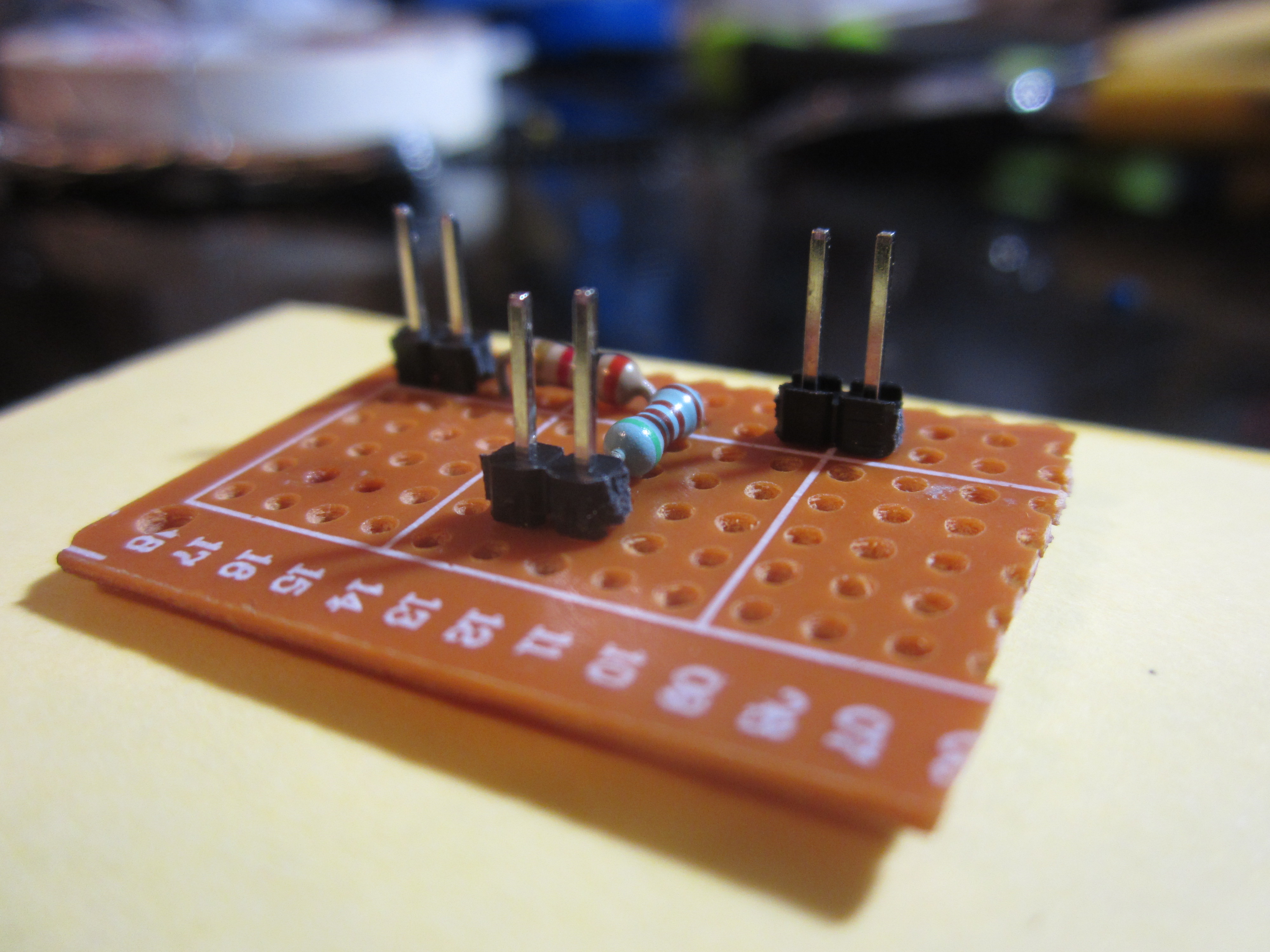
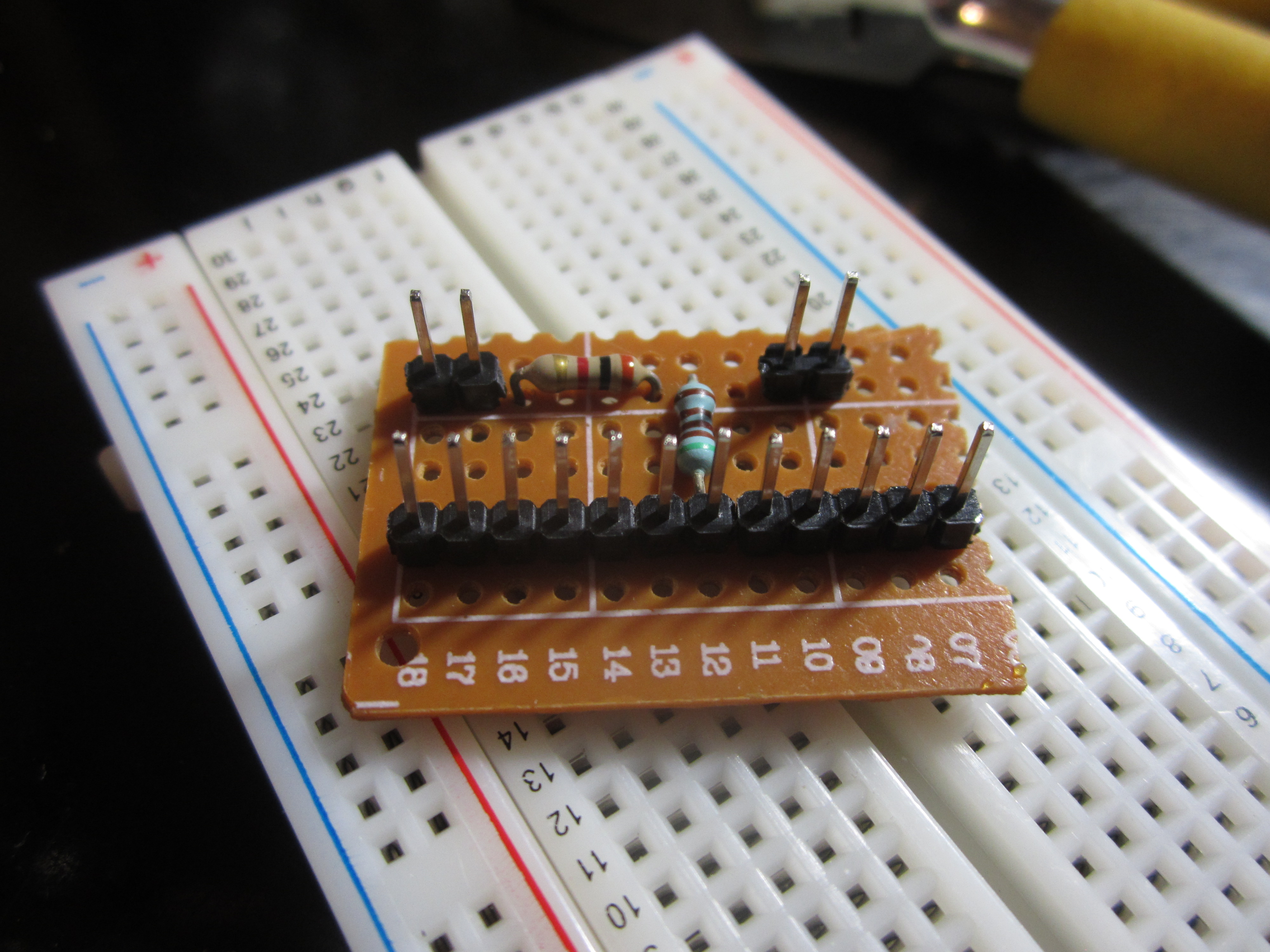
this is what I ended up with. and it worked beautifully with R1 = 1.8kΩ and R2 = 3.3KΩ
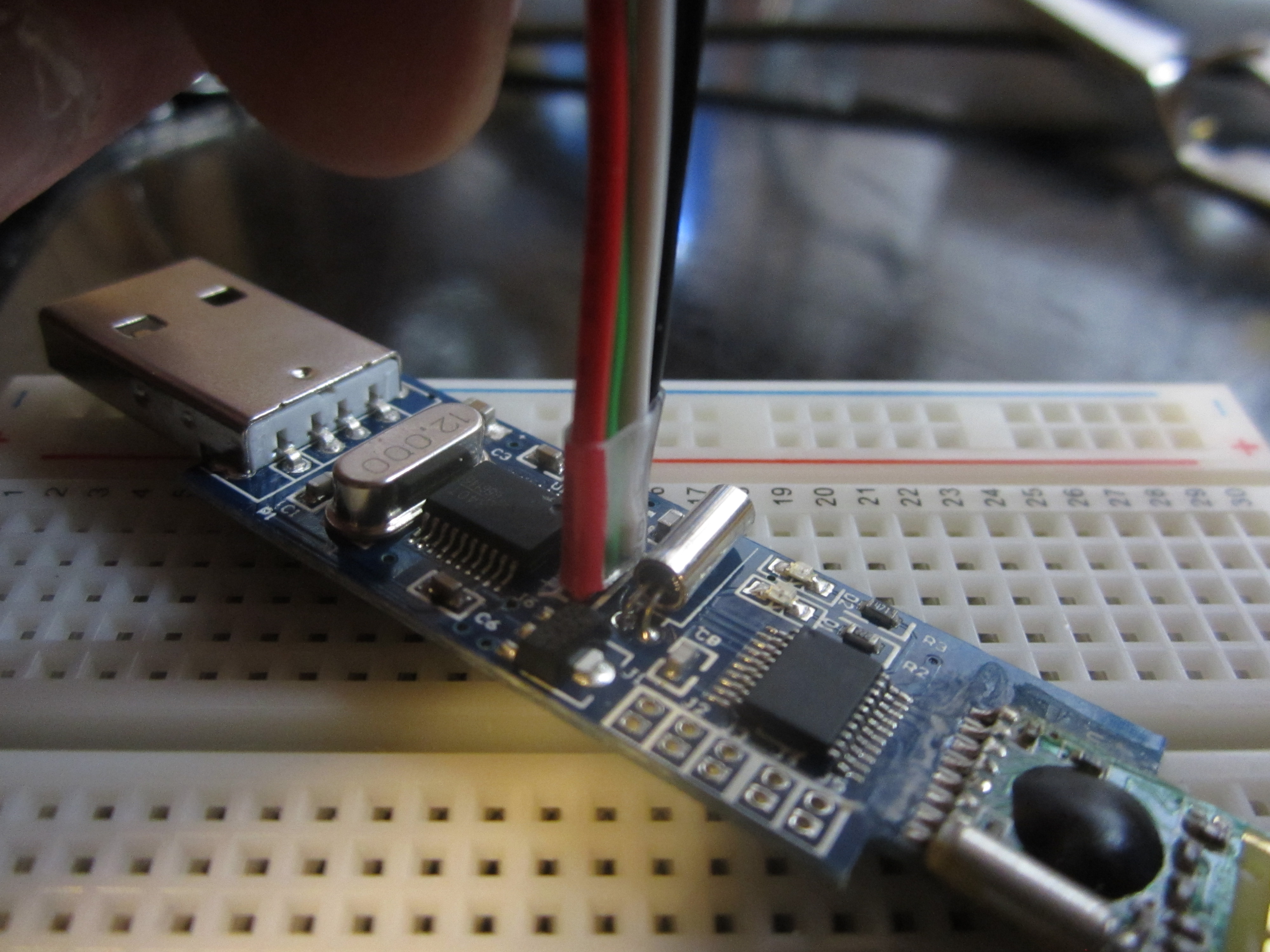
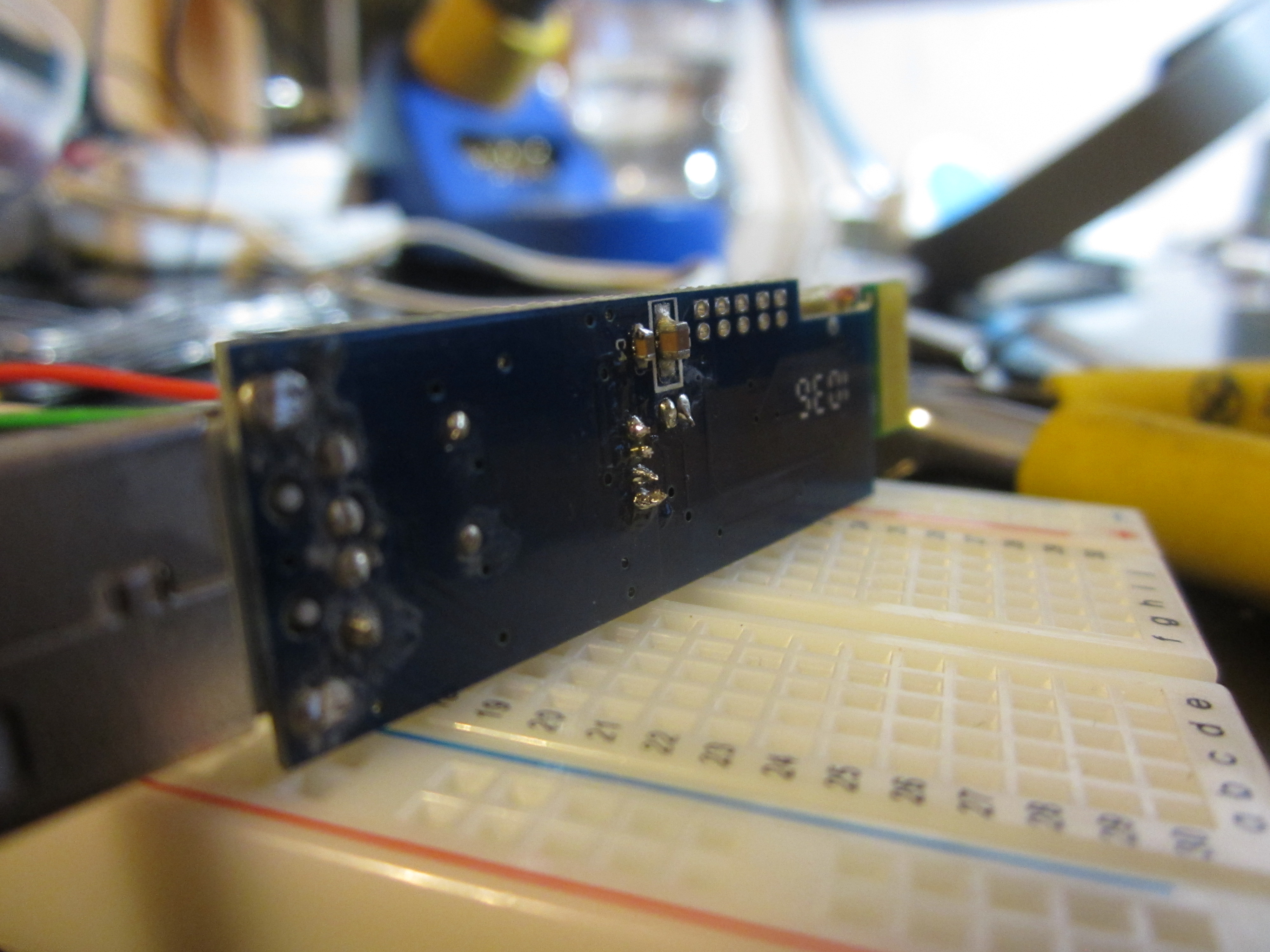 i also soldered wires to the pin-outs on the transmitter/receiver. note the shrink tube on the bundle as a stress relief and careful soldering on bottom to prevent shorts/bridges.
sigh...
so i sucked it up ordered a piece or two from amazon prime and paid for next day shipping and I will have it tomorrow. i realized as i continued to read up on the reasons why the voltage needed reduction that i could simply build a voltage divider as the team from Make a Mind-Controlled Arduino Robot had done. this is a simple process where you pass the voltage across two resistors in series leading to fractional adjusted voltage.

there are tons of calculators on the web, i used this one today and this one in the past to make multi-voltage supplies.
this is what I ended up with. and it worked beautifully with R1 = 1.8kΩ and R2 = 3.3KΩ
Thursday, December 10, 2015
a residency at Signal Culture (Owego NY)
for the past 24 hours i have been in what is known as the Finger Lakes area of Upstate New York. several months ago my application for the residency program at Signal Culture was accepted. the program bring researchers and creative interested in experimental processes in art and media to the village of Owego to give time to work on a project. i was awarded a two week stay and i elected to come in between semesters.
over the next two weeks, i will be practicing/experimenting with using EEG (electroencephalogram) data as a systems control input. yep brainwaves to run name-your-choice-of-physical-hardware. last summer i proposed a theatrical project to enable two actors to run puppetry from their biometrics. that project wasn't picked up and the project was put on the shelf. i applied for the Signal Culture opportunity to give me time to open it once again.

Signal Culture is in a three story brick building on North Avenue, a main artery through the center of the village. for my time here, i have a spacious 400-500 sq. foot studio with tables, tools and equipment/components. a big bedroom and private bath attach to the studio. the kitchen, dining room/library are on the 3rd floor as a shared resource with the other residents and the founders of the program. i feel incredibly fortunate, and i am very grateful for the support of Signal Culture and the UWF Art Department who have made it possible for me to be here.
Wednesday, May 29, 2013


Monday, May 27, 2013
Sunday, May 26, 2013
first SMT experiments
i used solder paste and my normal brutish sized soldering iron... this is magic!


Thursday, May 23, 2013

Wednesday, May 22, 2013
Otto's Ghost
some time ago i began to play with a solar sound circuit as research in autonomy, electronics, sound installation, etc. i had very vague feelings about how to build upon this project. this spring, i decided that my summer project would be to go for a truly embedded sound installation in the forest that surrounds our University of West Florida. it was very apparent that the many days of sun per year and dramatic shifts in the weather will create some manner of hybrid ecology of machine and nature as a resulting soundscape. in April, i applied for the Faculty Scholarly and Creative Activities Grant to seed the project. i applied for funding to pay for some new tools and to pay some summer assistants to help me realize the project. i am happy to report that it was funded.
 so i commence this summer in flurry of buying new equipment and starting a tremendous research period to learn more about PCB fabrication, Surface Mount Technologies, and mass production. i am building a reflow oven, refining my circuit design skillz, trying new techniques in applying resists, experimenting with new etchants, learning to apply solder masks, trying out conformal coatings, etc., etc.
here are gory details, pulled from my application:
my project with the working title, Otto’s Ghost, is a sound installation constructed from dozens of small solar powered circuits placed into the environment of a wooded site. the site and devices form a hybrid ecology between nature (landscape, trees, etc.) and technology (‘chorus’ of miniature sound robots expressing a variety of chirps, buzzes, etc.) Each module of the group can have an individual sound profile from the variety of the on board photovoltaics and values of components used in each piece. the soundscape manifests as the overall composition of the different ‘sonic speciations’ in the group and environmental factors. the generative soundscape of Otto’s Ghost is additionally influenced by environmental factors (diurnal cycle, weather, etc.) situating the environment as a coauthor in the score created by the installation.
Otto’s Ghost grew out of research from 2008, when i began to investigate autonomous machines and sound art in the installations of Ralf Schreiber (1996) who used the Schmitt Hex Inverter integrated circuit. the core circuit, the Schmitt trigger, is characterized by positive feedback where a portion of the output is fed back to input creating a loop gain (amplification) of the signal. this behavior was discovered by Otto Schmitt and documented in his 1937 dissertation on electrical propagation in nerve fibers of squid. Schmitt, now considered ‘a father’ of contemporary bioengineering, is also known for coining the term biomimetics.
Ralf Schreiber is a primary source in the application of these circuits as an aesthetic form. Like Schreiber, i am also using the oscillatory functions of the Schmitt triggers to create sound installations and feedback loops create chirps and buzzes. the current objective requires materials research to climate harden the devices to be implanted into the biological world. the project expands former research, first, in the transformation of the design and, secondly, by reinserting the machine embodiment of Schmitt’s inquiry as an element of the environment and a complication of the ideas of an ecology and (natural) systems to explore the aesthetics of an autonomous collection of machines as (machineorganisms).
Monday, May 20, 2013
a new etchant option

 for the past year or so i have been etching my own PCB's. i have experimented and successfully mastered many Toner Transfer resist techniques where a reversal image is applied with heat and pressure. i have had the kind support from our printmakers who allow me to use their Edinburgh Etch tank to burn the boards. and they have been really spectacular, it gives me much pride to deliver a project module to the students with home-brewed PCB's to work upon. it brings it closer to home on multiple levels.
on friday, i was leading a seminar for my summer work group who are assisting my summer project (stay tuned). in the seminar i demonstrated the entire process: drawing a schematic, PCB layout,resist transfer, etching, and then soldering the project. our printmaking facility is shut down for the summer so i did an etch in a photo tray in the UWF FabLab. this was fine as i only needed about 5 boards and it was fresh FeCl so it went relatively quickly. it has spurred me to take the next leap for our lab and start an official 'chemistry' policy in the lab to make sure the students can follow my lead and make their own custom PCB's.
i began more etchant research as i prepare for the discussion i need to have with our Environmental Health and Safety officers. i am concerned with the protocols we will need to establish for material handling and storage. even though we will need to comply to material handling for the 'used etchant' supplies, it would be wonderful to find other processes that use less hazardous raw materials and etchants that will last long term to reduce the waste stream.
for sometime i have been aware of a Hydrochloric Acid (HCl) and Hydrogen Peroxide (H2O2) etchant that seems to have a long life according to the citizen scienctitst and nerdom around instructables.com. the anecdotal evidence suggests that it has a long life that actually increases etching ability as it is used and that it can be extended by adding more oxidizing reagent (H2O2) or simply bubbling air through the mixture to facilitate the oxidation. the reports are that enthusiasts are getting very long usage times reducing the amounts of materials they dispose of. this is fantastic because cupric solutions are highly toxic to the environment and biology. it has even been suggested that electroplating techniques could be used to reclaim a less soluble (less hazardous) and recyclable copper powder. other advantages of this style of etchant is that it doesn't have the horrid staining that is characteristic of FeCl. it will still wreak havoc on your stainless steel sink so you need to exercise caution.
in the past 48 hours, became aware of a small but growing number of individuals using household vinegar (or if you will acetic acid CH3COOH) and H2O2 plus a little salt (NaCl) as an etchant. this well documented in the BLONDIHACKS blog post from Feb. 2012, where the awesome Quinn Dunki details the process of design to fabrication in awesome detail. and here and Steve Hobley has run similiar experiments as detailed in blog posts from 2011. kind of cool is that he has a chemist in his family who comments on the chemical processes at work here and makes it a totally interesting read.
the remarkable point is that common vinegar runs about 5% acid by volume where a considerably stronger corrosive is usually employed.
 i had to do this! tonight i returned to campus with 3% peroxide, household vinegar, and some salt. i can report that it works very well. slower than the fresh FeCl etchants, but very similar to time need when using the Edinburgh bath we have in the printmaking department. in about 30 minutes, i had etched a one ounce copper plate. as Quinn puts it "not having to deal with storage, use, and disposal of a strong acid is worth it."
i have a close associate in photography and thus access to some pretty aggressive Acetic (it is used as a stop) that we can mix down to a reasonable but higher percentage by volume. i can also get vinegar in up to 30% by volume. this is used as weed killer, but it also looks like it is a lightly regulated as a chemistry. i am also thinking of running some tests citric acid which i could pickup at the local brewing supply house. all of which could make the requirements for Health and Safety easier!
i will be running another board tomorrow morning in the resultant etchant, it should go quicker if the reports are correct. and post images... stay tuned!
Wednesday, May 16, 2012
Teensy
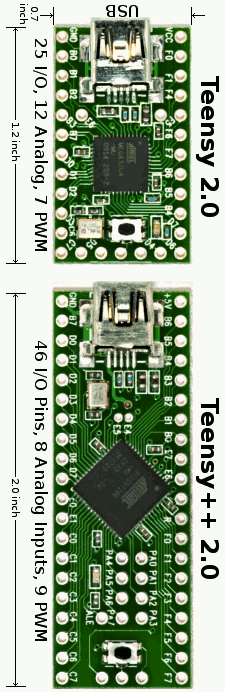 recently, i bought some Arduino clones known as the Teensy 2.0 from PJRC. the device is thumbnail size at 1.2 in. by 0.7 in., a ATMEGA32, and boasts 25 I/O, 7PWM, and 12 analog pins. there are many small clones available on the market, but most of the designs require you to use a FTDI breakout board. i was really sold because the Teensy includes a USB jack and all for $16 to $19 for the model with pins already attached. the ++ version offers 46 I/0, 130MB and is only a few dollars more.
i have purchased these as part of a wearable i am designing and hopefully i will be telling you all about very soon.
Wednesday, May 09, 2012
my students are rad and squeaky
this is a followup from the post earlier this year about a circuit from my friend, Andre Castro. here are three homebrew instruments from the PhysiComp class
Saturday, July 09, 2011
the Kickstarter campaign marches on
i am discovering that fundraising is a game in the truest sense. it is not that i am specifically looking for loopholes to game Kickstarter. i have just come to the conclusion that the whole nature of raising money for a project is actually a quest based resource gathering system with tons of variables. I can compare it to a kind of puzzle quest that requires solving to unlock the next in the quest line. fundraising requires a balance of tone and honesty; no glory-hounding but not feel embarrassed about saying that we really believe this to be a cool project. and the way you say it is so different in formality and tone depending if you are addressing the Dean, a friend, or a philanthropic agency.
we are about 10 days from the deadline and very close to 50% which has raised our visibility on the Ks webpages considerably. i believe that if we can get a few more bucks from several people—can you spare a $10, friend?—that we will be well on the way to getting on the front page. we have pulled ahead of two CNC projects as of this week which is no mean feat because those project are very important right now.
so...
if you are one of my readers/friends even a $1 helps so please consider donating. here's the link
we are about 10 days from the deadline and very close to 50% which has raised our visibility on the Ks webpages considerably. i believe that if we can get a few more bucks from several people—can you spare a $10, friend?—that we will be well on the way to getting on the front page. we have pulled ahead of two CNC projects as of this week which is no mean feat because those project are very important right now.
so...
if you are one of my readers/friends even a $1 helps so please consider donating. here's the link
Wednesday, March 16, 2011
privacy bot
Niklas Roy has definitely created one of the best physcomp projects I have seen in some time. Check out Privacy and Net Curtains
Subscribe to:
Posts (Atom)

