Saturday, November 19, 2005

Questions and Methodologies


So this gradual student wants to inform his artmaking more effectively and fulfill the assignment for Art 105 by Profesora Otto. (BTW I have been staring at the ceiling for 72 hours with li'l to no cognitive activity, leading me to think that I am possibly the love child of the unknown fourth Stooge. Thank the Gods on High for Insomnia!) In the pursuit of such endeavors here is some wacky and hair-brained shite:

questions to ponder:
what is the nature of time? (eww this should be trouble)
I will add more as my mind allows

methodologies

Uno
(1)video, no kiddin'. This foist methodology is straight forward video project. Manipulate the TV experience.
(2)no visual shots of timepieces, daylight, or phenomena such as celestial bodies
(3)audio can be linked to compensate for the video exclusions
(4)no narration who needs it, plus I am talking about experiential concepts can I achieve it without feeding that TV generation mind, mst have auditory component
(5)one continuous shot that can be looped seamlessly, time has no start/end
(6)duration between 3 and 5 minutes cause I like odd numbers : )

Zwei
(1) no video. no shite?! installation is not always video dependent
(2) uses technology that anyone can assemble or that is easily available
(3) auditory component
(4) cycles in 3 minute period has a beginning or end

TrĂªs
(1) incorporates video and installation.
(2) visualizes and must form a spatial experience
(3) cycles in a 3 (or more) minute period
(4) audio
(5) hmmmmmmmmm

Defintions

Time: to go the defintions please follow this wikipedia shortcut link for the complete page and links. The abstract nature of the concept of Time has confounded philosphers, scientists, etc. for thousands of years. The debate and effort to define this phenomena continues to contemporary times.

Let us consider these definitions, as put forth by Wikipedia:


Attempting to understand time has long been a prime occupation for philosophers, scientists and artists. There are widely divergent views about its meaning, hence it is difficult to provide an uncontroversial and clear definition of time except its physical definition, which dictionaries give as "a non-spatial linear continuum wherein events occur in an apparently irreversible order." This article looks at some of the main philosophical and scientific issues relating to time.
The measurement of time has also occupied scientists and technologists, and was a prime motivation in astronomy. Time is also a matter of significant social importance, having economic value ("time is money") as well as personal value due to an awareness of the limited time in each day and in our lives. Units of time have been agreed upon to quantify the duration of events and the intervals between them. Regularly recurring events and objects with apparently periodic motion have long served as standards for units of time - such as the apparent motion of the sun across the sky, the phases of the moon, the swing of a pendulum.


Friday, November 18, 2005


Meeting with Stanford's Solar Oscillations Investigation (SOI) Lab


The Observatory Team met with Philip H. Scherrer, Principal Investigator and Deborah Scherrer of Educational at Stanford's Solar Oscillations Investigation (SOI) Lab. The team presented the proposal to investigate the proposals goals, information, gather more information, and to request support. Deborah pointed out that it is actuall fallacy that irrepairable damage is done by staring into the sun. This was shocking news and I am not ready to personally do experimentation on this effect. This team and all of it's associates make no promises and discourage anyone from performing this act. Phil suggested I focus on the fact that the Sun could bee observed 24hours per day in my structure.

I reported the poor results in my findings on the play testing of the screensavers. Phil and Deborah informed me that this did not suprise them as the data stream coming to the SOI Lab comes irregularly. They were additionally suprised that EIT 195 updates every quarter hour.

Phil said he thought my idea was reasonably achievable to gather data more regularly. He saw issues with only projecting a real time image because of the relative quiet period we are in with Sun's cycles. It was suggested maybe we play some peak activity footage from the ten years that SOHO has been in flight. We checked the time period for the festival and the satellite should be operational during that period.

Deborah has contacts with other solar labs and said she would make some contacts with them for the Observatory Team. She knows of programs developed at UC Berkeley and UT. They were encouraging that some equipment maybe able to be loaned to our team in the pursuit of this project. Deborah was also going to check into an inflatable system for the structure. Additionally they have offered to make introductions to the Lockheed team build the next generation of Solar research platforms.

The SOI staff also offered webspace for the Observatory site and materials for the public. They provided samples to the team, including a punchout and fold together spectroscopy kit!

Overall Phil and Deborah were very encoraging. They agreed it is a good public outreach and thought it was a good project to pursue.

Wednesday, November 16, 2005

methodologies discussions


The class discussed our methodology procedure for the last project. In general the class was very uncommitted. Some of the ideas thrown at the wall to see if they would stick are:

options:

group projects
group methodology
independent methodology
Group projects completely failed (thank the gods on high!). Group methodology and independent methodologies were pretty well split down the center in supporters because of this Susan suggested the following variant: A group methodology that you either follow strictly or break every stance. In other words: take it or break it!

We started a list of standards which seemed to be coming out very arbitrary such as:

1. video
2. 1 to 5 min
3. all original footage
4. no repeat shots
5. possible: no man made set

We took a 5 minute break because this all seemed unsatisfactory and when we returned Susan requested that we have three methodological questions such as "what is your relationship to technology?" to compare with the rest of the class. For Friday night early Saturday morning a blog entry of 5 rules and the justification for them. Susan and I agree :we don't want arbitrary hurdles.

Other things to do before Monday:

research content
play with final cut pro to learn new
learn about artists to reference, project to reference

Thursday, November 10, 2005


Image: Hot Shots from SOHO. EIT 195 (Extreme-ultraviolet Imaging Telescope) image from a Coronal Mass Ejection (CME) and Particle Storm on July 14, 2000.


Update to the Observatory Project


Today Sarah Lowe and I had a conference call with Steel Hill and George Dimitoglou from the SOHO project at the Goddard Flight Center in Maryland. As you remember, SOHO is the Solar and Heliospheric Observatory, a sattelite launched Dec 1995 cooperatively run by the European Space Agency (ESA) and NASA. SOHO houses several types of detection equipment and monitors the nearest variable star to earth, yes I mean the Sun. This data is collected both for research purposes and practical purposes such as keeping communications networks operational.

I presented the Observatory/Oculus proposal to Steel and George. I then requested help in developing a data feed from the sattelite to be able to project a near real time image of the Sun mediated through the satellite 24 hours per day for the length of the Zero One festival. My request had two specific points. (1) Does the SOHO lab receive data faster than the 4 hour periods published on the public website and (2) can I get a dedicated connection to this more frequent data so I can feed it into a software to control the projections.

(1)George informed me that the EIT 195 (Extreme-ultraviolet Imaging Telescope) reimages every 15 minutes. Thus this might be a reliable image to animate for the public.

(2)George and Steele directed us to screen saver software in the public side of the NASA/ESA. George said it might just have the animation techniques I am requesting available. The software already downloads the latest images from the website.

Additionally, George and Steele have promised support to the project in providing materials for public consumption.

Wednesday, November 09, 2005

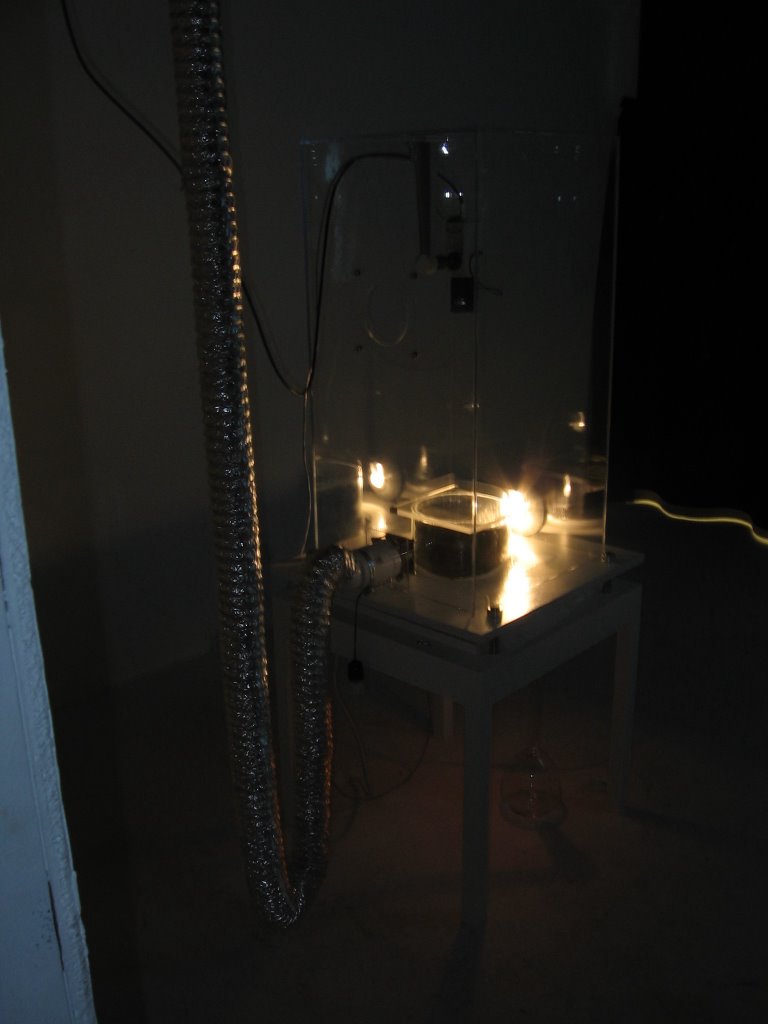
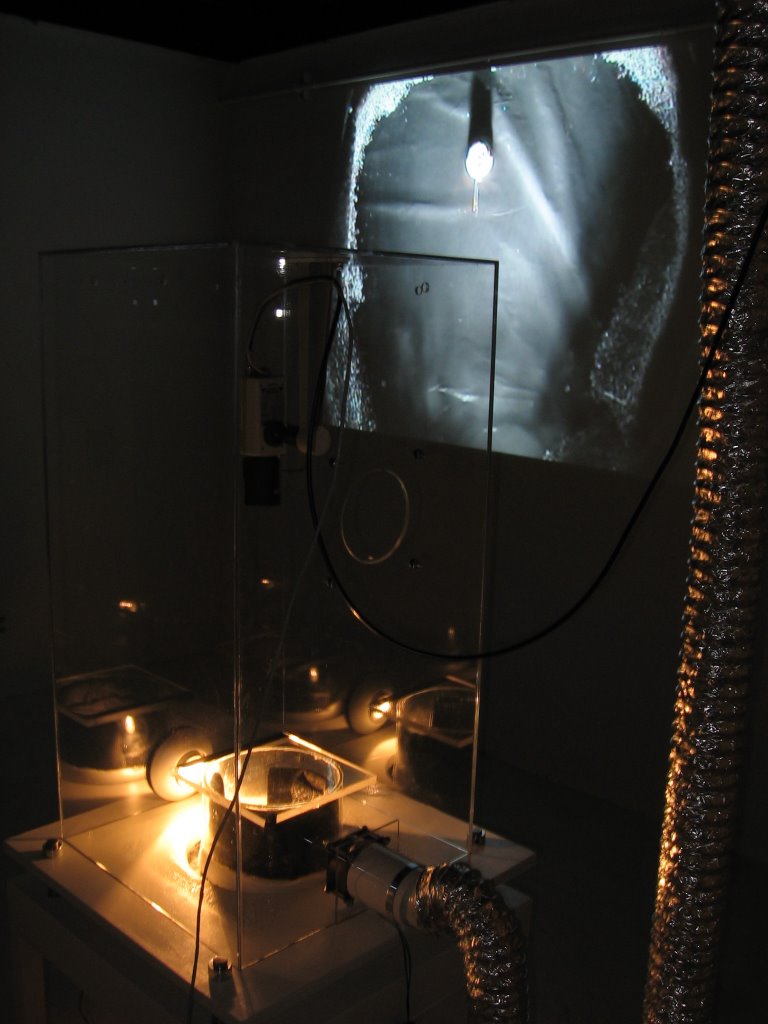
Cloud Chamber Mark VI


This is the sixth version of a prototype particle detector I have built over the last 3 years. I see Mark VI and its’ kindred are a continued metaphor on the themes of the nature of reality. Whereas painting is an extension of the illusory reality like the shadows in Plato’s Allegory of the Cave, these projects allow visual evidence of reality that intersects our lives constantly yet lies beneath the usual visual perception.

This tool, known as a Langsdorf Cloud Chamber, allows one to witness the passage of some of the fundamental particles that make up everything in the universe as they pass unhindered through our world. Like spirits they pass through air, earth, and flesh and bone. We are in rivers of energy. It ebbs and flows around and through us and thus questions the concept of inside and out. The fact that this is the same material that makes all things questions the reality of individuality and distinctiveness.

Discussion of the project:


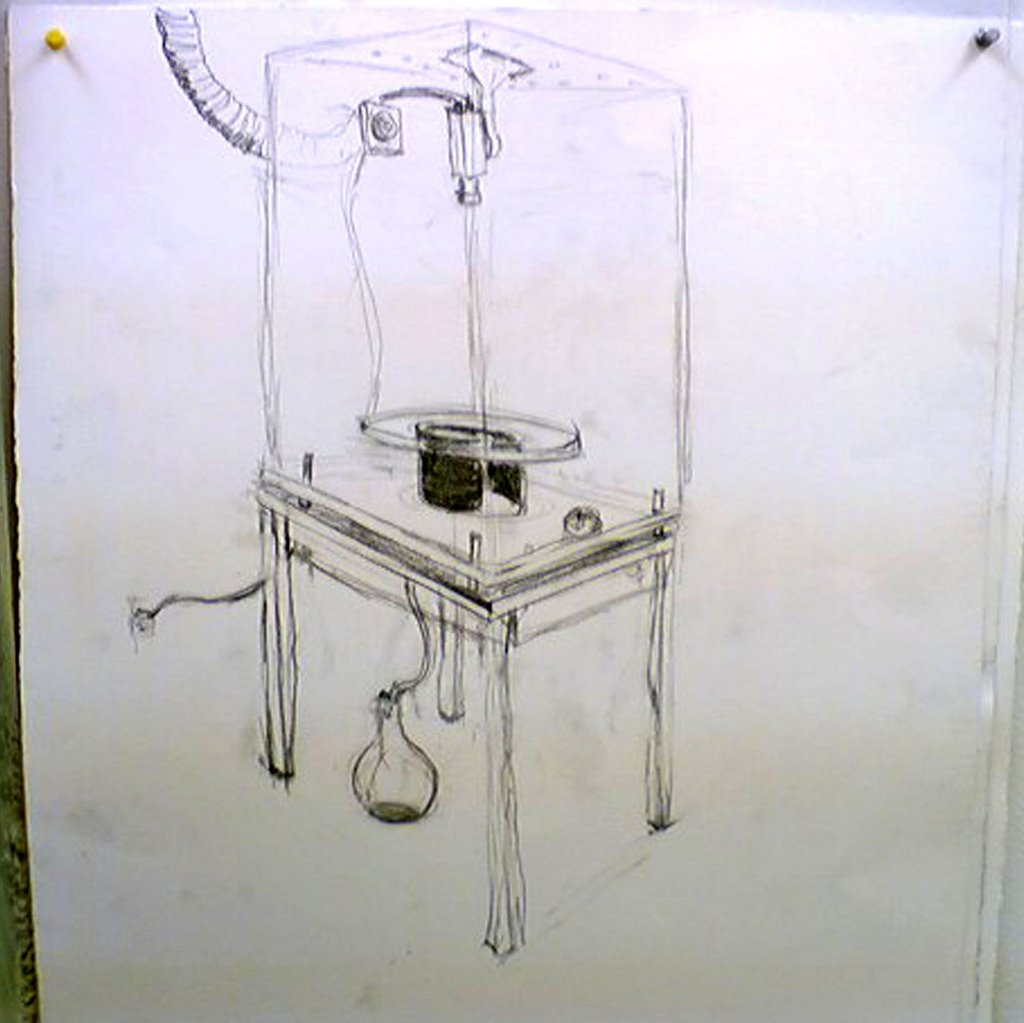
The cloud chamber project was recontextualized in a new format. The concept was to roll out the chamber in a transparent fashion revealing all of the components. The picture above shows the drawing I made in early October that started to form this idea. In my project I wanted to achieve a few (1) make a formal and aesthetic modernist statement in white and transparent media, (2) do good science, (3) have both of these themes play against one another to suggest the philosophical ideas I am concerned with. The fact that one can approach the experiment from all angles except below is highly effective strategy bridging those concepts of good public science and aesthetics.


Mark VI Technical


My scheme in this version is to illuminate all the parts and solve the problem with the focal length on the camera. In previous generations I had to adjust the camera as the angle the dry ice sublimated. The plexi structure solved the first issue by revealing all the parts; of course this required me to be very precise and neat in the fabrication, you cannot patch plexi very easily. The focal length issue was solved by making the table top ride down as it rode on ice. Four pins are intersect the platform holding ice as well as the second top on which the experiment sits. As the ice vaporizes*, the experiment and camera descend as a unit solving the earlier problem.
*dry ice goes from solid to vapor without turning to liquid at standard earth temperature/pressure, thus it is dry.

For two weeks straight I put in 15-18 hour days in the wood shop, making 5 or 6 trips per day to the hardware store to buy stuff, fabricating the Plexi box, doing research at the plastics shop. The actual craftsmanship became nerve-wracking. Even though all of the component took amazing focus, the custom work on the plexi box was a prime example.

Once the basic box was fabricated I needed to attach all of my equipment, which required careful cutting and milling of the plexi box. This took a lot of patience, as this material can be super fragile when cutting. Plexi shows any mistake so every surface was cleaned and padded between each move. Measure, make one cut, carefully clean, pad, measure, and so forth. Then repeat the procedure again. On top of that, the material costs were $200.00, the threat of breaking the materials meant I had to go excruitating slow: think out every procedure, discuss them with the shop manager, etc.

It was very important to me to fabricate each and every part of the experiment device. A few parts of course are off-the-shelf: the video camera, the fan, the ventilation hose... Overall I wanted to be the author of this sculpture. I wanted to use glass on the chamber itself for the longevity of the material. In the past I have used acrylic tube. The experimental components degrades acrylic. When I was offered a collaboration by Jeff Sarimiento of the SJSU Glass Lab, I eagerly accepted his proposal to make the experimental vessel. Mr. Sarimiento made a glass cylinder to my specs with the help of the glass blowing students. I feel that this custom labware only added to toward the formation an aesthetic object.