Wednesday, May 22, 2013

Otto's Ghost


some time ago i began to play with a solar sound circuit as research in autonomy, electronics, sound installation, etc. i had very vague feelings about how to build upon this project. this spring, i decided that my summer project would be to go for a truly embedded sound installation in the forest that surrounds our University of West Florida. it was very apparent that the many days of sun per year and dramatic shifts in the weather will create some manner of hybrid ecology of machine and nature as a resulting soundscape. in April, i applied for the Faculty Scholarly and Creative Activities Grant to seed the project. i applied for funding to pay for some new tools and to pay some summer assistants to help me realize the project. i am happy to report that it was funded.

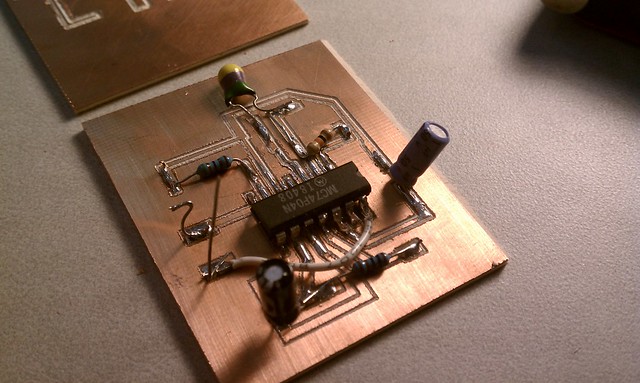
so i commence this summer in flurry of buying new equipment and starting a tremendous research period to learn more about PCB fabrication, Surface Mount Technologies, and mass production. i am building a reflow oven, refining my circuit design skillz, trying new techniques in applying resists, experimenting with new etchants, learning to apply solder masks, trying out conformal coatings, etc., etc.

here are gory details, pulled from my application:

my project with the working title, Otto’s Ghost, is a sound installation constructed from dozens of small solar powered circuits placed into the environment of a wooded site. the site and devices form a hybrid ecology between nature (landscape, trees, etc.) and technology (‘chorus’ of miniature sound robots expressing a variety of chirps, buzzes, etc.) Each module of the group can have an individual sound profile from the variety of the on board photovoltaics and values of components used in each piece. the soundscape manifests as the overall composition of the different ‘sonic speciations’ in the group and environmental factors. the generative soundscape of Otto’s Ghost is additionally influenced by environmental factors (diurnal cycle, weather, etc.) situating the environment as a co­author in the score created by the installation.

Otto’s Ghost grew out of research from 2008, when i began to investigate autonomous machines and sound art in the installations of Ralf Schreiber (1996) who used the Schmitt Hex Inverter integrated circuit. the core circuit, the Schmitt trigger, is characterized by positive feedback where a portion of the output is fed back to input creating a loop gain (amplification) of the signal. this behavior was discovered by Otto Schmitt and documented in his 1937 dissertation on electrical propagation in nerve fibers of squid. Schmitt, now considered ‘a father’ of contemporary bioengineering, is also known for coining the term biomimetics.

Ralf Schreiber is a primary source in the application of these circuits as an aesthetic form. Like Schreiber, i am also using the oscillatory functions of the Schmitt triggers to create sound installations and feedback loops create chirps and buzzes. the current objective requires materials research to climate harden the devices to be implanted into the biological world. the project expands former research, first, in the transformation of the design and, secondly, by reinserting the machine embodiment of Schmitt’s inquiry as an element of the environment and a complication of the ideas of an ecology and (natural) systems to explore the aesthetics of an autonomous collection of machines as (machine­organisms).

Tuesday, May 21, 2013

follow up on the etching

today's test:

note the vivid blue today because more copper chloride is in solution

Monday, May 20, 2013

a new etchant option


for the past year or so i have been etching my own PCB's. i have experimented and successfully mastered many Toner Transfer resist techniques where a reversal image is applied with heat and pressure. i have had the kind support from our printmakers who allow me to use their Edinburgh Etch tank to burn the boards. and they have been really spectacular, it gives me much pride to deliver a project module to the students with home-brewed PCB's to work upon. it brings it closer to home on multiple levels.

on friday, i was leading a seminar for my summer work group who are assisting my summer project (stay tuned). in the seminar i demonstrated the entire process: drawing a schematic, PCB layout,resist transfer, etching, and then soldering the project. our printmaking facility is shut down for the summer so i did an etch in a photo tray in the UWF FabLab. this was fine as i only needed about 5 boards and it was fresh FeCl so it went relatively quickly. it has spurred me to take the next leap for our lab and start an official 'chemistry' policy in the lab to make sure the students can follow my lead and make their own custom PCB's.

i began more etchant research as i prepare for the discussion i need to have with our Environmental Health and Safety officers. i am concerned with the protocols we will need to establish for material handling and storage. even though we will need to comply to material handling for the 'used etchant' supplies, it would be wonderful to find other processes that use less hazardous raw materials and etchants that will last long term to reduce the waste stream.

for sometime i have been aware of a Hydrochloric Acid (HCl) and Hydrogen Peroxide (H2O2) etchant that seems to have a long life according to the citizen scienctitst and nerdom around instructables.com. the anecdotal evidence suggests that it has a long life that actually increases etching ability as it is used and that it can be extended by adding more oxidizing reagent (H2O2) or simply bubbling air through the mixture to facilitate the oxidation. the reports are that enthusiasts are getting very long usage times reducing the amounts of materials they dispose of. this is fantastic because cupric solutions are highly toxic to the environment and biology. it has even been suggested that electroplating techniques could be used to reclaim a less soluble (less hazardous) and recyclable copper powder. other advantages of this style of etchant is that it doesn't have the horrid staining that is characteristic of FeCl. it will still wreak havoc on your stainless steel sink so you need to exercise caution.

in the past 48 hours, became aware of a small but growing number of individuals using household vinegar (or if you will acetic acid CH3COOH) and H2O2 plus a little salt (NaCl) as an etchant. this well documented in the BLONDIHACKS blog post from Feb. 2012, where the awesome Quinn Dunki details the process of design to fabrication in awesome detail. and here and Steve Hobley has run similiar experiments as detailed in blog posts from 2011. kind of cool is that he has a chemist in his family who comments on the chemical processes at work here and makes it a totally interesting read.

the remarkable point is that common vinegar runs about 5% acid by volume where a considerably stronger corrosive is usually employed.

i had to do this! tonight i returned to campus with 3% peroxide, household vinegar, and some salt. i can report that it works very well. slower than the fresh FeCl etchants, but very similar to time need when using the Edinburgh bath we have in the printmaking department. in about 30 minutes, i had etched a one ounce copper plate. as Quinn puts it "not having to deal with storage, use, and disposal of a strong acid is worth it."

i have a close associate in photography and thus access to some pretty aggressive Acetic (it is used as a stop) that we can mix down to a reasonable but higher percentage by volume. i can also get vinegar in up to 30% by volume. this is used as weed killer, but it also looks like it is a lightly regulated as a chemistry. i am also thinking of running some tests citric acid which i could pickup at the local brewing supply house. all of which could make the requirements for Health and Safety easier!

i will be running another board tomorrow morning in the resultant etchant, it should go quicker if the reports are correct. and post images... stay tuned!

Thursday, August 02, 2012

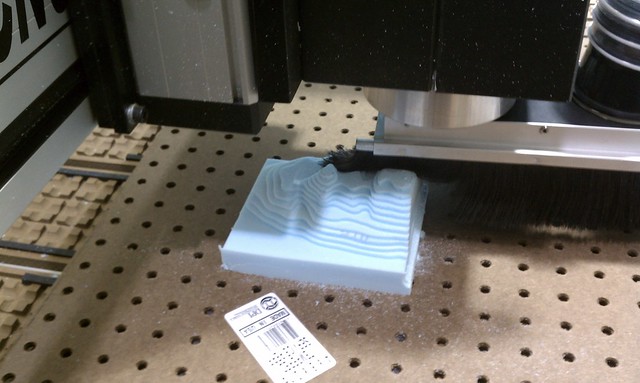
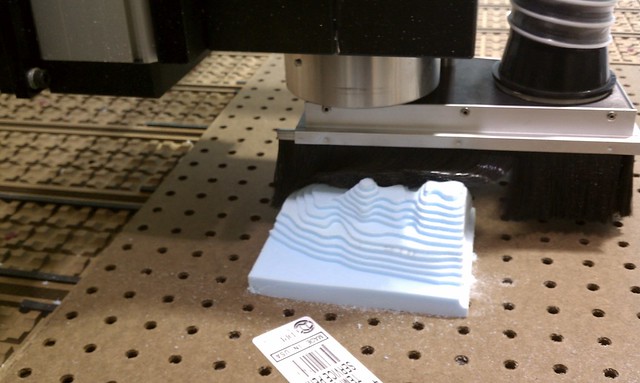
research results on the TechnoCNC

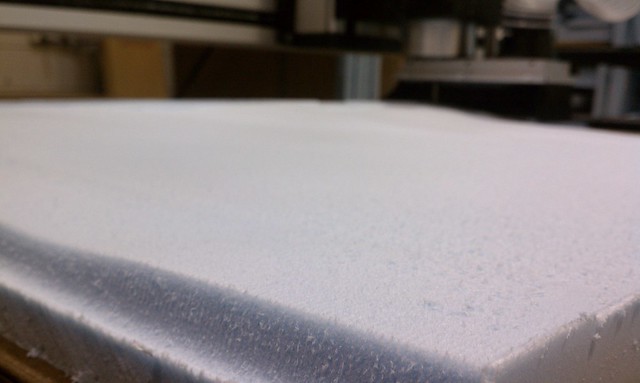
for the past 5 weeks at the UWF FabLab i have been training on the machine. the device is a TechnoCNC L4896 (4ftx8ft) with vacuum and tslot. we are running a Porter Cable 3.25HP router to spin the endmill.

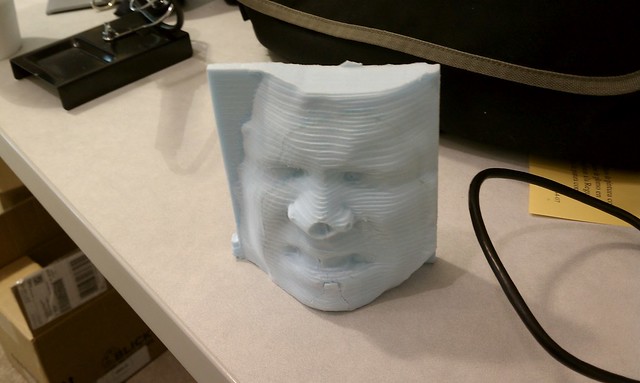
in the beginning i couldn't get the right tool profiles to load, but i was still able to sculpt my likeness.


once I got the tool profiles dialed in the resolution was much much better

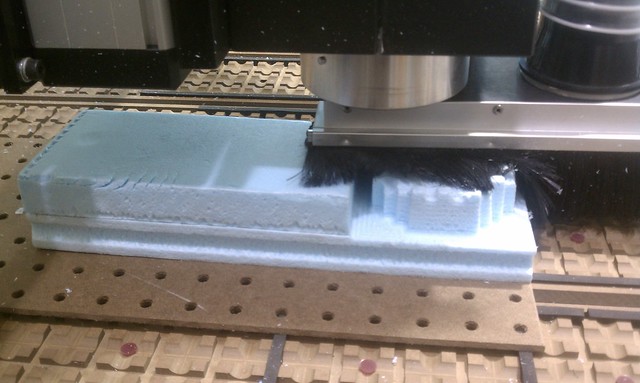
I exported some Minecraft models and some USGS topo data to the machine:


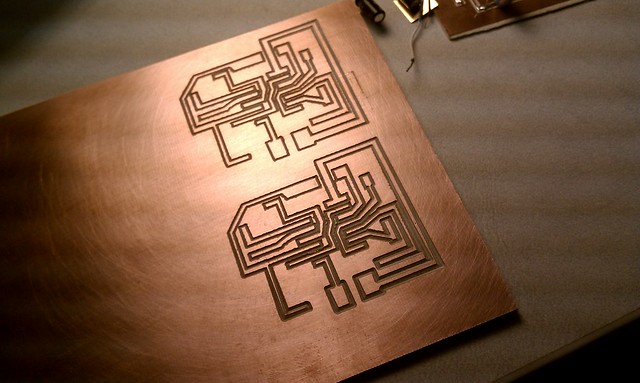
and now i have sucessfully discovered a workflow for using this giant machine to mill my circuit boards:


Sunday, June 03, 2012

the Neutrino Food Labs is raging today

the Neutrino Food Labs is raging today, i started an experiment to culture my own cider yeast. over the past few weeks, i have been pining away for a good glass of home brew. we are very lucky locally because about 1 year ago the Pensacola Bay (micro)Brewery opened; they make a fine Brown ale which i have used as a component for my own fine chili. i am also spurred on by the price of a decent beer at the supermarket; last week when i wanted to grab a six pack for a small gathering i was holding the average price for a sixer of my favorites in domestics and microbrews was over $10. oooch! i went with a Leinenkugle specialty brew for about $8.

oi, i was feeling mighty sad this morning when the urge to brew came on strong. i keep missing the brew shop hours, they are closed Sundays and Mondays, because i generally have meetings all the rest of the week. then i saw an instructable by member, creasemaker, where he had sucessfully cultivated his own cider yeast from organically certified apples. not too many months ago i cultivated a strain of yeast for my sourdough breads, following some lore published by Peter Reinhardt. to do this, i soaked some organic raisins in warm water and slowly fed the critters in the tea flour and purified water. similarly, creasemaker took apples and soaked them in a good quality apple juice. my fingers are crossed and i can't wait to report back.

secondly, I was inspired by all the chatter on 'cold brewed' coffee so i started a pot today. i was impatient and i have dug into it after only 6 hours and it is amazing. very similar to a really lovely espresso, i think it is very high octane. i feel like i have taken some speed. lovely, delicious, Pete's French Roast speed, that is.